Saturday, October 07, 2006

Networking

If there is something you are passionate about in your efforts to change the world ( small steps) and you want other people in your area to know about it, you could register with the Action Network which has been set up by the BBC. It should give you some idea about what is happening in your area, who is doing something to create a change on a small scale and enable you to network with others in your area or community.

For instance :

  • You might want to share your produce and belong to a Lets scheme
  • You might want to collect old growbags and recycle them into enriched compost
  • You are concerned about your school closing and want other to know about it.
  • You are starting a knitting group ( just in case)
  • About sharing transport
  • Get in touch with other people in your community

SHARING BOOKS ON SIMPLE LIVING

This is a neat idea submitted by AK

Hello,

I'm an Aussie in Japan and have been reading your lovely blog for a few months. I don't remember exactly how I found it, perhaps from the Path to Freedom site ...

Anyway, some of my friends and I here have another way to enjoy books (English selection in libraries is limited!). We began a book circle where each member sends the next on the list a book on the first of the month. It does cost postage, but if you meet the next friend, you can simply hand it over. But it is wonderful getting a 'new' book in the post each month - like lots of birthdays! The next month, you pass that book on to the next person. If there are 6 members, your own book will come back to you 6 months later. We also write a comment sheet that is inserted into each book, so at the end you can read everyone's reviews.

I feel happier knowing that some of my treasured books bring enjoyment to others, and that the 2,000 or so yen I spent on them is shared. Postage for the average book costs around 300yen, so that is a considerable saving, even without thinking of environmental and simplicity issues.

Happy reading!
AK


If any of you are interested in getting a simplicity book circle going that way in the UK, email me and we can see how we set that up.

Poem


Dreams
">

Mostly, I would like to be remembered
As someone who was passionate for life.
The days of unsought ecstasies are numbered,
However long we linger in the light.
I was one who cultivated wonder,
Less of one contented to explain,
Delighted by the promises of hunger,
Enduring for their joy the years of pain.
Gifts I had aplenty: Some I savored,
Others sacrificed for others' needs.
Remember me as someone who was favored,
Despite constraints, to tumble in the leads,
Ocean to what winds I could not be,
Nightrider through what worlds I could not see.


Anon

Friday, October 06, 2006

Energy gadget

Here’s one that might be fun to have around, although I am struggling a bit with the price of the Wattson.

If you are geeky, you want to save energy and you have about £ 350 to spare, go for it and let us know how you are getting on with it. My geeky nature would say, wow neat toy, but then again, I can use paper, eyes, pencil and head to do the same work.

Innovative idea......


Fear -v-Love

If you have heard enough about the Amish post - look away.
What follows is a wider perspective I have had today about that.
What do we usually do when we are hit by violence? We go in denial, retaliate, we create boundaries of fear, we ask why and we want revenge.
Imagine being shown a different way, a way in which it can be recognised that it can be overcome with Love, forgiveness and support?

Yes it is probably easier to summon an army, create guns and go after the ‘ other’ party that has injured you and your family. Does it not say ‘ an eye for an eye and a tooth for a tooth’. That would be one way of reacting and one we follow quite often.

Over the last few days, we have been shown an alternative way to respond. We human beings have the power to stand united, in love, together and consider all the victims of a situation and they can be found in both areas of conflict. And instead of firing a gun we could, maybe we just could reach out a hand and see that the other person is hurting just as badly and listen to that pain. This has got to be hardest thing to do, and yet if the Amish are capable of doing so, that means we are humanly capable of doing this and we do not always have to start fighting.

Guess that,s what diplomacy does, trying to find the common shared beliefs and values and build a dialogue around that. Its Ok to be angry, its Ok to feel pain ....the real courage comes from meeting whatever happens with compassion, love, forgiveness and courage.

Think about it and how together we could apply all the love, compassion, forgiveness to the earth and all its people. It needs courage.....


reaching out to the Amish people


Amish Study #1833
">
I have admired the way of life the Amish lived, the plain and simple life the Amish Communities live, for many years now. My library has many books about their way of life and although their segregation from the world is considered strange, their way of life has a lot to teach us about looking after the earth, our family, forgiveness and service. They are hard working families, living and working together, looking after their families, old and young. Their way of living may sound romantic from books, but it is also a focussed life based on their beliefs and their strong faith. That this way of life and their children would meet with such planned violence makes it a very sad occasion.

It is always difficult to reconcile whatever drove the man to do what he did, with the death of young children, as well as the traumatic impact of this on all the families concerned. The Amish work, care and worship together and do not like to be put in the limelight. Forgiving is at the heart of their religion and this surely has to be the most difficult of times to carry that through. Yet in order to heal and understand what is happening, they will most probably do exactly that because not forgiving the death of their children would give the occasion more life and negative energy in the world. This is a bravery that as a mother, I would find hard to do, in fact neigh impossible. These are not my children and yet I can only imagine what I would think feel and do.

You may know that they have been put in the limelight over the last few days as a result of a man shooting children in their community schoolhouse. This is the equivalent to 9/11 to their society, a hit from nowhere. This touched my heart deeply. I am not sure that I would be that forgiving if it happened to my children and yet, that is their belief, to be supportive to eachother. My work was in supporting families. Despite a tragedy, these people rally around their families, the families affected by this shooting and support in every way possible.
Compare the way the Amish react to this tragedy and what happened when hurricanes hit Missisippi? They may look like a closed group of people, but when their world is hit, they forgive and get together to rebuild their lives. I admire their dedication ,faith and belief in hope. It is my hope that this tragedy will be used for good........in some way or other.

If you want to find out how the lives have been affected, you can see an update on Homemade Simplicity ‘s blog.

Especially in a simple life, deaths of family members are felt very deeply.

In any life, the death of a child upsets the natural order of things.

Thursday, October 05, 2006

Books on a budget


I am quite addicted to books, It has not always been so. As a child I was surrounded by books and my parents read a lot. Books represent knowledge to me and one of my learning styles is still learning through reading books and then applying the knowledge in a practical way.
Books however, add to stuff. That is the sad fact about them. Sometimes I really want a book and have it on my shelves so I can refer to it from time to time. Cookery books with recipes are like that, knitting books are like that and I have a great stack of gardening books.
Ordering by simply clicking at Amazon and having the book sent to me, originally maximised my pleasure, books make good gifts. I used to have magazine subscriptions too and yet apart from giving me that lovely feeling that is equated by putting my feet up, reading a book, eating a piece of cake and drinking a cup of tea or hot chocolate. Ah warm evenings ahead by the fire. My antidote to summer days, a fall day, a winter day, a small walk, and then home for a browse through the library. Poetry can also be found in books and in a recent assignment I wrote;
“ The relationship and the process happening to the reader of a book have the power to enable the reader to evolve, to learn and to grow by integrating the learning within their own levels of functioning. Jane Austen’s book Pride and Prejudice, written in 1830, although not a face to face encounter, nevertheless has the ability to engage me on a variety of levels of functioning as well as providing me with a character study for this essay.”


I have however a wish to reduce the ‘ stuff’ in my life and needed to look how I could change that automatic consumerism that had crept into my life.
As its raining today, I ventured out of the house on a little mission. I have an adventure book in which I write what I want to do so when I find myself with a little time and no idea what I could do with it ( this does not often happen), I can look at my plans and make an outing.
I had indicated in the adventure book that I wanted to reduce waste, stuff and in applying this to books I thought I would go and explore exactly what it was about books that was so important to me.
Apart from the above, I realised, walking in a bookshop that I like the experience of browsing books, followed usually by a pleasurable drink at Starbucks ( mentioned previously) and then a little moment of glee at looking through the books I bought.
I don’t think I explored alternatives lately, mainly due to ill health, but also because I now realise that it is so easy to stay stuck in patterns we have created.
I did find the town library. A large building with a different sort of atmosphere than a bookshop, ( it is not that enticing actually, the posters are missing!)but I can browse the catalogue which has been laid out like the Amazon lists with reviews ( did not know that?), and although some of the books on my list to read were nowhere to be found, I did browse by category and came home with a small selection. It did not cost me a penny, the books that is.
I also noticed that they have a CD library, video and DVD library and spoken books which sounded inviting. I took a little trip down memory lane and took out 2 CD’s which meant a lot to me at some stage in my life. ( that cost me £ 2, but would have cost me £ 30 on itunes!)Nice to reminisce this afternoon with that at very little lost. OK, I did need to drive to town but I can incorporate that in my planning. They also do a coffee shop in the library now, so maybe that is worth exploring. There is also a great reference library and study area, magazines, newspapers and periodicals to browse through.

All in all I could be having the experience without cluttering my home, spending money and creating packaging and books travelling miles to get to me.

I do believe that libraries do accept donations of books so thats worth finding out about if you are de-cluttering. Share your enthusiasm and knowledge with someone else. Reduce waste, clutterm spending but maximise the experience. From now on, I will consider a trip to the library followed by an indulgent experience at Starbucks as a treat. Go on, inspire someone else, read, write and share your joy with someone else.


Little Boy Reading Book in Library">

Wednesday, October 04, 2006

BREAD MACHINE ENERGY USE

Thanks for the comment of the energy audit. I posted the energy calculator earlier this year whicc may give you some info on usual appliances. Looking back at the post I underestimated the amount used per day as I stated it as 15 units as where in reality it is 18 plus.

How do you do an energy audit?

Read your electric meter, gas or water meter at a starting point for 1 month and then devide by the amount of days - this should give you daily output.
Based on the fact that certain items run 24 hours per day, you take a reading before you go to bed and then when you wake up, the difference should give you an indication of the energy eaters that are continuous. If you have data for 12 hours say, and it shows you have used 2 units then you can be assured that your appliances use that when you are not doing anything with them. This could be anything from alarm clocks, videos, computers on standby but also fridge, freezer etc.
The calculator can then be used backwards to check whether what you are estimating is actually correct.
( Scientific methods)

There will be fluctuations by season etc. I am now doing the audit every month to see whether what I am changing has actually an effect on the overall consumption. As stated, I need to find a balance between the energy I need to use ( comfort level) and the one where I am going to feel deprived. In the meantime, I log the info, make small changes and monitor.
Winter for instance is predicted to increase energy supply due to more lighting, indoor activities etc but I will not find that out until I do this audit. There are no hard and fast rules as it will all depend on how many people in your household and what you use.

The breadmachine usage I use is a Panasonic one and I gave it 0.5 units per day as I used a daily loaf. If you are on low cost night electtricity you could use the timer to make the loaf and cut that amount by a small percentage.

Pay as you throw

Councils begin 'pay as you throw'

Councils face tough decisions over what to do with waste
More than 30 councils are fitting microchips to wheelie bins to work out how much households are throwing away.
It is the latest attempt to encourage more recycling to curb the amount of rubbish that ends up in landfill.
The chips would weigh the contents of the bin to within 500 grams.
The Local Government Association is expected later this year to propose councils be given greater powers to change the way people remove rubbish.
Many councils are in favour of "pay as you throw" and are already anticipating the changes, according to the information uncovered by BBC One's Real Story.
But Paul Bettison, chairman of the LGA's Environment Board, appreciates that certain councils have taken the wrong approach.
"Any council that's issued chipped bins and hasn't informed their residents I would say has scored something of an own goal. We need to work with the public and it's sad that seemingly some councils didn't," he said.
Chipped bins could record the date, time, bin identification serial number and the weight and the contents of the container.
Once weighed, a bill for the waste would then be sent to the owner.
Tough fines
With an estimated nine years of land fill space left, councils up and down the UK are faced with a tough decision about what to do with Britain's waste.
Simply burying rubbish in the ground is no longer an option.


Local authorities now face tough fines from the Government on what they do bury, to force greater levels of recycling.
Each council has introduced different recycling systems to encourage householders to separate out their waste and put less in their main bin.
But in some areas recycling is now compulsory, meaning if people do not comply, rubbish will not be cleared away and they could face prosecution.
Alternate weekly collections are one way of tackling the problem but they have not been warmly welcomed by residents.
Claire Harvey, from New Holland in North Lincolnshire, faces a weekly struggle to get rid of her waste.
"The council only actually recycle newspapers, glass and tins," she said.
"The plastics and the cardboard you have to dispose of yourself. They have provided a system, but they need to collect the domestic waste more frequently."
Paul Bettison believes that if people want to keep weekly collections of all household waste they will have to face the reality that it is going to cost them.
"You are paying for a collection every week and that is what you are still getting," he said.
"And now if you wanted us to collect both bins each week that would mean doubling the number of collections and that's fine and actually that would add approximately £100 a year to your council tax.
"There may be people who wouldn't want to pay that."
Real Story's report on rubbish is on BBC One on Wednesday 4 October at 1930 BST.


Still here

Life is settling back to normal, Dad is on the mend and we can settle back into our comfort zone.

At the beginning of October I checked the amount of energy electricity units we have used and average is down to 18.3 for September so I am well pleased with that. Things we did were :

turning computers off not just putting them in sleep mode
Changed washing machine programmes to less running time

This month I am doing an audit on the appliances we are using and whether they are required. I.e. how vain am I to use a hairdryer when I do not go anywhere, could I cut that down maybe?

The garden requires still tidying up mode, the pumpkins and butternut squashes are harvested. Herein the UK we will be celebrating harvest festival. Its a community thing, it culminates in a harvest supper where we get to chat, drink and be merry and toast our gratefulness of the harvest safely gathered in.
I love fall or autumn, not because it gets cooler, but because there is a richness of colour and scent, both inside and outside and it signals time to rest. The garden will rest and so will I, feet up, reading books and planning my garden plots for next year.

Saturday, September 30, 2006

Little break

There seems hours of work to do in the garden to currently clear up beds and do some fall planting. As autumn mellowness fills the air, I can be found in my kitchen making apple pie, chutney and all sorts of items.
I am needed by my family at the moment as my father has been admitted to hospital. My priority is my relationships and how I fulfil these currently, so if I am not posting for a while, it is simply because when it comes to the crunch, I go where I am needed and my thoughts need to be a bit closer to home.
One of the bonuses of downshifting has been that I have time to devote to relationships, as before other things materially seemed to get in the way. In the final analisys very little matters other than being with the people we love and simply being with them and holding them through a difficult time.

Monday, September 25, 2006

Saving water

Conserving water as a vital resource.....
On average we use 70% more water today than 30 years ago.

❑ Take a shower instead of a bath - showers save water
❑ use a glass of water to rinse your teeth as leaving the tap on uses 10 litres
❑ Fit a water saving device on your toilet cistern to cut back on the equivalent of 2 baths of water used to flush your toilet.
❑ When making a cup of tea, only fill sufficient water for your needs, rather than filling it to the top and heating that up.
❑ Use a bowl to do your washing up, using environmentally friendly liquid means you can then pour the grey water on your garden.
❑ Only use the dishwasher when it is full.
❑ Water plants in the garden with a watering can using harvested water. A garden hose uses a lot of water that evaporates on hot days. (also good exercise)
❑ Look at clay pot irrigation
❑ Don’t cut the lawn too close- longer grass sends down deeper roots and reduces weeds.
❑ Use water used for bathing to water your plants.

Remember that water is a necessity for living.......

Thursday, September 21, 2006

The tail of Hurricane Gordon

The weather has been hot today and the winds have been picking up speed. Hurricanes are rare in the Uk, only every couple of years so the announcement of the tail end of one is always a bit of a shock. Its certainly part of a different world where weather patterns become more unpredictable.

Here’s the advice from the met office

Make sure you know what to do
Before the storm
        •        Secure loose objects such as ladders, garden furniture or anything else that could be blown into windows and other glazing and break them.
        •        Close and securely fasten doors and windows, particularly those on the windward side of the house, and especially large doors such as those on garages.
        •        Park vehicles in a garage, if available; otherwise keep them clear of buildings, trees, walls and fences.
        •        Close and secure loft trapdoors with bolts, particularly if roof pitch is less than 30°.
        •        If the house is fitted with storm shutters over the windows then ensure that these are closed and fastened.
        •        If chimney stacks are tall and in poor condition, move beds away from areas directly below them.
During the storm
        •        Stay indoors as much as possible.
        •        If you do go out, try not to walk or shelter close to buildings and trees.
        •        Keep away from the sheltered side of boundary walls and fences — if these structures fail, they will collapse on this side.
        •        Do not go outside to repair damage while the storm is in progress.
        •        If possible, enter and leave your house through doors in the sheltered side, closing them behind you.
        •        Open internal doors only as needed, and close them behind you.
        •        Take care when driving on exposed routes such as bridges, or high open roads, delay your journey or find alternative routes if possible.
        •        Slow down and be aware of side winds, particular care should be taken if you are towing or are a high sided vehicle.
        •        Do not drive unless your journey is really necessary.
After the storm
        •        Be careful not to touch any electrical/telephone cables that have been blown down or are still hanging.
        •        Do not walk too close to walls, buildings and trees as they could have been weakened.
        •        Make sure that any vulnerable neighbours or relatives are safe and help them make arrangements for any repairs.
Reproduced by permission of the Building Research Establishment

Price of fuel check

Reducing the use of a car is great but getting fuel for the best possible price also means less money to spend. At petrolprices.com they search the service stations in your area and you can also get an email update as to where the cheapest fuel is within a designated travel radius. It may only be pennies but as most cars take more than 30 l fuel in, its worth knowing where the best price is.

The website is also full of useful information on sharing lifts and a useful blog that keeps you updated with tips on reducing car need etc.

If you are starting a college course, why not find out if anyone closeby travels the same way and see if you can share their transport costs. Liftshare.org can find out whether anyone close to you goes the same way.
If you are cycling to work or wanting some more info on how your employer can introduce a cycle to work scheme with tax benefits, check out the Department of Transport guidelines.

Summary on transport costs

✓ Reduce the use of your car by planning journeys or sharing transport
✓ Reduce costs of fuel by checking out where the cheapest supply is located near you.
✓ Try alternative ways to go from A to B, use a travel planner to compare costs, time etc
✓ If you consider cycling to work, see if your employer has a scheme if not why not tell them about it.


Wednesday, September 20, 2006

Continual produce

It can be daunting to create a vegetable garden that produces a full range and enough for a family. During my recent library trip, I came across a book by Lia Lendertz offering a half hour allotment plan. This book clearly shows what to grow on an allotment or large garden, how much of each plant etc. It prompted me to create a small excell spreadsheet ( very sad) with the amounts of veg I wanted to grow and when it all needs planting. It takes a more scientific approach avoiding the glut and famine of the home grocery and in principle you should be able to provide sufficient all year around.
As its September, it suggests this would be a sewing time here in the Uk for Spinach and Garlic and time to plant apple trees, october is the time to plant redcurrant bushes ( 2 for a family of 4) and in November you should sew mangetout peas 1 10ft double row.
I think its a useful exercise to look at what the garden can produce and how that can be strategically achieved. You can tell I was in financial planning can't you...the skills are however as relevant to cabbages as they are to money.

We are spending quite some time clearing the garden and preparing it for winter. A bed is being cleared of weeds and plants to make way for a peach tree and sunflower plot next year.I am also working on putting the claypot irrigation system in place.

Monday, September 18, 2006

On elderberry cordial

Thanks for leaving a comment about the elderberry cordial, could not reply directly as there was no email address to get back to, but here is the recipe:

Elderberries (still on stalks)
Sugar
Cloves
Cinnamon sticks (1 per each pint of liquid)

Pick the fruit on a dry day ,stew with the stalks in a large stainless steel saucepan, with just enough water to cover.

Strain through muslin squeezing to get all the juice.

To each pint of juice add 1 lb (450g) of white granulated sugar( or brown sugar), 10 cloves and 1 cinnamon stick.

Boil for 10 minutes.

Cool ( syrup is very hot) and bottle in sterile bottles with good quality plastic screw-on tops making sure you distribute the cloves evenly amongst the bottles (they act as a preservative).

The cordial can be used immediately, and will keep well for a year or two. I also keep some in the freezer ( leave some room at the top of bottle for liquid to expand)

Taken with hot water it is renowned as a guard against colds, and a glass a day through winter is a wise precaution..

Original recipe is from paul's elderberry page ( http://www.patch-work.demon.co.uk/elder.htm#H)

Saturday, September 16, 2006

Garden dyes off

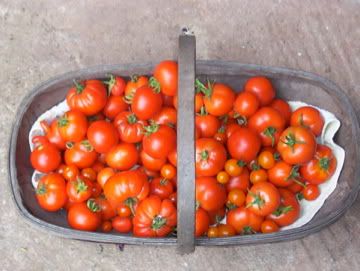
The garden has had enough....the plants and trees look tired and they are dying off. The tomatoes are ripening fast and there is plenty of work to do clearing space and making the beds ready for the next occupants. I managed to find another 7 lbs of tomatoes on the vines which I promptly put in the freezer. I have my fill of tomatoe soup, chutney, puree and ketchup for the winter to come so this time, I am being a bit lazy and putting them in small bags straight in the freezer. Apparently when you need to use a tin of tomatoes in a dish, you plop the bag in boiling water straight from the freezer, the skins will fall off and then you just add the tomatoes to the dish. Sounds simple in a complicated world.
My cabbages are being eaten by yet another generation of white cabbage fly........I do look after them I do, so am walking along to kill off some caterpillars. The reason you ask? They turn into butterflies, that lay eggs and then these turn into caterpillars. I have been too kind this summer but next year I am going to be more picky ( pun).

What to plant now.....
I put in some winter lettuce mix, which is mustard seed, mizuna and mibuna and a few weeks ago planted my last lot of carrots to go in the polytunnel. Its still very dry, the waterbutts are getting empty and the leaves are drying on the plants. All in all it was a good season but I am planning to be a little more organised next year. One of the projects is to use claypot irrigation and see if that makes the watering a little easier. Its good to plan.

Thursday, September 14, 2006

ARCTIC ICE SHRINKS

Almost daily there is some reporting on global warming, the effects on other countries of the way we use our energy. The latest story is the shrinking of the arctic ice.

I may be more aware of it because I am interested in it, as other people may completely go into denial about the situation.

I thought I would illustrate a common process happening to humans when they have a shock, be it through ilness, death, loss of any kind so you can see where abouts you are in the cycle.

It starts with shock,......
.........then comes denial
...........then comes anger and guilt............
..............then comes despair.............
.................then comes acceptance..............
.................then comes relocation........

Relating this to the news of global warming....where abouts are you?

It could be something like this......
Global warming, flooding in Bangladesh, changes in arctic ice ( shock, possibly)
Ah...that has nothing to do with me.( denial)
How is it possible that this is happening? Is it my fault? Why do politicians not act?( anger and guilt possibly)
Its hopeless for any individual to do anything about it...we are doomed.( despair)
We may be doomed but to effect change I am going to have to make changes now and its going to be hard and cost me money.( moving to acceptance)
heck, this is hard, giving up things( despair mixed with acceptance- some go back to denial)
I wonder what solutions I can find to change things around here ( acceptance)
Downshifting, community and communication........( relocation)

The most difficult and tricky point comes when you come out of despair and depression and realise that the way forward is going to be hard, acceptance and the need to change. This is where most people hit rock bottom, not when they hit rock bottom but when they are aware what needs to be done to make change happen.
It takes on average 2 years for people to journey from shock to relocation........where are you on this journey?

Wednesday, September 13, 2006

Energy conservation report

My energy supplier offers a free energy efficiency check on our home, by questionnaire,which implied that I would find out where I am and how I can reduce my energy requirements by taking simple measures.
It arrived today and frankly, I was disappointed, It gives our house an energy efficiency rating of 40% ( 100% being maximum ). The measures that increase efficiency are considered to be as follows :
1. Loft insulation
2. Double glazing of windows
3. Low energy lighting
4. solid fuel closed room heater
5. dryline the walls

Doing all of these would increase my rating to 70 to 80% and here is the interesting bit, see if I got that right:

Estimated potential running costs would come to £ 860 per year and my annual savings would be £ 490 per year which to me means that it is actually going to cost me £370 more than I am spending now. Maybe compared to another person’s home that makes sense but I was hoping to become more energy efficient without it costing me more each year. Was that unrealistic?

It did however include a leaflet for warmfront who will provide a grant to make your home warmer if you qualify. Central heating probably increases the value of your home, I am told by the local estate agent that ‘ people expect it’. I would love to have central heating but even if it is installed I wonder whether it is practical to have it running when ‘people expect it’.

My question is this, how does gas central heating make environmental sense? What heating other than solar or wind powered at the moment makes environmental sense? Currently we use logs to heat our stove in the living room and a gas stove which heats our water and does our cooking and also provides heat in winter in the kitchen.

I decided to explore on wikipedia and came up with this, an article about the environmental cost of wood, and yes it appears that it has an environmental cost.

Wood is said to be a greenhouse gas lean form of heating since the combustion of a tree releases the same amount of carbon dioxide as is bound up by a growing tree. Therefore, for this to be true, the resource must be managed accordingly. As far as the carbon dioxide released from the energy used in the processing and transport of heating wood, it does contribute to global warming.

Taking this into account, wood is a low cost energy, which is renewable if you manage a forest nearby and you do not need to travel far with the energy source. The reason for us using wood is that it grows on our land, and for every tree we cut, we plant another one.
Against that would be the use of gas and other fuels but the costs of manufacturing, transporting and delivering these is higher because they get delivered by road.

Electricity appears to be the most energy efficient but the cost of it is the highest.
A calculator can be found here.
So my thinking is as follows :

I have wood available, so I might as well use it,as long as I manage the amount I use and replace what I am using with new trees.
Electricity can be produced by using solar panels which is what I am investigating at the moment.


If you have any suggestions on how to deal with the cold ,apart from central heating, why not share it?

Ad free blogging

Photobucket - Video and Image Hosting


You may have noticed that I have done a bit of housekeeping here today, no more ads and hopefully a clearer oulay of the blog for you to read. I had not even noticed the hypocrisy between having a blog about downshifting and reducing consumption and then having some adds on it to get you to buy. It appears that I still have some un brainwashing to do. I am working on it though.

It all adds up.....***pun**

Tuesday, September 12, 2006

Your uniqueness

“There is a vitality, a life force, a quickening that is translated through you into action, and because there is only one of you in all time, this expression is unique. If you block it, it will never exist through any other medium. It will be lost. The world will not have it. It is not your business to determine how good it is, nor how valuable it is, nor how it compares with other expressions. It is your business to keep it yours clearly and directly, to keep the channel open.
You do not even have to believe in yourself or your work. You have to keep open and aware directly to the urges that motivate you. Keep the channel open. There is no satisfaction whatever at any time. There is only a queer, divine satisfaction, a blessed unrest that keeps us marching and makes us more alive.”

Martha Graham to Agnes de Mille


LOVE


Isn't she lovely?

Sunday, September 10, 2006

And then there was the gas rebate

Just when I thought I was going to have to find some extra money a letter arrived with an incredible message. It was a bit like the card you draw in monopoly, the community chest card......we have noticed that you have paid too much, we overcalculated your usage and we will be sending you a cheque for X and be reducing your monthly payment by 25 %. I like getting these type of letters.

To give you an idea of the recent changes on my utility bill:
Gas now reduced by 25%
electricity up by 2 %
food consumption reduced by 50% ( not lost any weight though)
water utility bill is standard we are not on a meter.
Cable TV, managed to reduce regular payment and haggle.
TV line rental, reduced by 5%.

Some of it goes up and others go down, in general terms, money out is less and consumption is less.

Other changes that have had positive effects on our budget :
DVd and games rental...no longer buying. This is a halfway point as after some time we will not be accumulating games ( stuff) and hopefully interest will wane.
Using the library instead of pushing the amazon button. Hard one to do and occasionally I treat myself when they do not have the book in the library.
Growing our own food has made a big change to how much I cook and how much packaging is produced in this household.
Using the car for essential journey only and sharing transport has reduced our fuel consumption.

Its good to see it on paper ( or screen).

To reduce computer and TV time I am going to invest in a wind up timer and give us all more focussed time to play with.


The energy debate

Summer procrastination is over. I do not watch TV a lot but yesterday I saw an interview with Al Gore about the energy crisis and global warming etc etc. It reminded me why it is that I am doing all this stuff. One step at a time, now, not in 10 years time when it will be harder and harsher to do.
Al Gore wants people to take up the changes necessary and as we change , so will the politicians. Politicians are not going to tell us to change things because we have a comfort zone and actually what we are going to have to do is to give up some of those in order to save lives in the future.Granted, technology will come up with solutions, but we can be creative, use our resources, the brain ....to come up with creative, innovative ways ourself. You do not even have to reinvent the wheel, there are many of us already doing this. The reason for this blog is to show you that an ordinary woman, with 4 kids, can make changes. Some are more popular than others but the solutions we find as a family, the savings and changes we make have an impact on what we then do. Less is really more when you get going but you need to switch off the consumer messages in your head, on the TV, in the papers...and switch on your own creative brain..working out a plan for a life that is worth living to you, a life that has value, a life that will be sustainable in the future.

To make changes, in any business, even a life business, you need to know exactly where you are at. I have said this before on money matters and it also holds true on energy matters. Despite many changes in lightbulbs and usage habits, I thought our energy consumption would go down. Imagine therefore my disbelief when I heard that my electricity payment was being increased. I wanted to investigate why. One of the reasons is that the unit price has gone up but secondly, it appears that our consumption also has increased. How is that possible?

Your electric supplier has all these facts on hand on a computer somewhere. This is what I found out. We have increased our use from an average of 19 units per day to 21. As it turns out, some of the changes we made to save water have increased our energy output. Let me explain that one. A bath, uses a lot of water but in this house, we have a tank of hot water each day regardless of whether we use a bath or not. It is heated by gas so our gas consumption is unaffected. We cannot change the process, it heats up our range cooker which heats up the water as a by product. Changing to showers has reduced the amount of water we use but increased the amount of electricity we use. A 10 min shower uses 3.75 units. There are 5 people in this house although some wash more often than others ( there is no right way in this, no preference, its individual). So making this change has affected our electricity usage. To put that right we can balance individual showers and shared bathwater.

The other items that use a lot of units are as follows :
Dishwasher uses 2.5 units per load
washing machine uses 2 units per wash
dryer uses 2 units per load
computer uses 1 unit every 4 hours, so if you leave it on 24 hours it will use 6 units.

Why do I fret about it. I don’t but I want to install solar panels in the future and enable this house to generate some units from that. There has to be a balance between what it can produce and what we use.


Our washing machine has a 7kg load and we can be more careful in using it when it is full and when the clothes are dirty. We hang them out to dry in the summer. Dishwashing could be done by hand.

Against everything is the convenience of time. Everything in the simple life, requires less money and more time and as you consume less, you have more money to spend on the things or people that really matter to you.

Appliances in our house have a certain lifespan and when they break we can repair them, we can look whether we want to replace them at all, and replace them with energy efficient appliances or with muscle power. It all depends how driven you are on this issue.

My boys looked incredibly at me as if to say ‘ and you spent all afternoon establishing how many units we use per day?’ Yep, I did because finding out and creating your baseline gives you the information to make changes if you want to.

Friday, September 08, 2006

Temptation


Photobucket - Video and Image Hosting


This picture tickled me, sent by a friend...must know my weakness.

Autumn glow

Its happening, the light is changing and all outside plants are being bathed in an autumn glow. Inside, the glow is due more to using energy, canning and working at a hot stove. Still canning tomatoes today. Question currently going on in my mind is how much food we actually consume over a year. Last year I could not manage missing a shopping weekly, then created menus to see what was needed and have managed to work that up to a monthly shopping trip. I am aiming to increase that knowledge learnt to make 12 monthly menus which will then give me a formula for which foods need to be grown, bought and stored. I am sure this is what the pioneers did. How many days can you live without going to a store?

Thursday, September 07, 2006

KITCHEN ALCHEMY

Another 14lbs tomatoes later........trying to make ketchup. This is another plastic bottle we use quite a bit of and then have to recycle. I have created 3 pints of ketchup today, the kitchen smells well....like ketchup but the real test will come in a few weeks time when small boys taste the end product.

Wednesday, September 06, 2006

GLUG

What exactly is Glug? Glug is our new washing liquid. It is not available anywhere in the shops, quite exclusive! Another eyeopener. We love soft fabrics against our skins which meant that we went through 3 bottles of washing liquid per month in addition to 2 bottles of softener. Glug has changed all that. I used this recipe here. The second day I had a mass of slime at the top and water underneath and wondered whether I had done the right thing. I used a large balloon whisk to make it equal to the washing liquids we have bought so far.My Dh suggested pine fragrance and I added some essential oils to it but its not a fragrance I would recommend as it reminds me of disinfectant at the moment. Orange or lavender and camomile will be the next ones to try. 9 out of 10 washes turned out great with great washing power......and no softener required. My question therefore is whether the manufacturers make the powders so harsh that you have to use softener to deal with the residue of the washing chemicals. Some of my children have skin allergies and we have had to be very careful in choosing the right chemicals to bathe them in ( sarcasm!). Glug solves all these problems, no allergies, no plastic bottles to recycle. I am searching for that clean cotton smell.......

Monday, September 04, 2006

Shopping day

Today was the day, the one and only day that we go shopping in the month. I used to go shopping whenever the need or fancy took me there but these days, I go once a month and follow my list carefully made as the month goes on. It provides a focus. Sometimes things get crossed off and sometimes an impulse buy does creep in. Its become an interesting experience instead of a dull one. Today, the must have list was small, some shoes for DS 1, some tea for me and a treat.......a visit to Starbucks. I used to enter very frequently there and now again,I savour the delight of my chai tea latte, sip it very carefully. The flavour and sensual experience has to last a month. Of course I could go more often but the whole point about voluntary simplicity is that it is voluntary, I have choices and I choose to engage with my visits fully, knowing why I am in town, what I am looking for and then going home having really enjoyed my time out. Starbucks, what an extravagance.....only once a month and when I am in there, sipping tea, I people watch enjoying the variety of transient people sharing the same space as I do. Did we spend much, probably not as the norm goes, but as far as we were concerned, we spent enough.
Our monthly expedition in town has not only become more focussed but also much calmer. The boys walk patiently, they are not too extremely bored because we do not wander aimlessly. They know exactly how much money they have to spend and make informed choices about what they need and how they make that money stretch until the next trip. They even offered to carry my bag and get my tea at Starbucks which is a form of politeness I have rediscovered in them. The point is this, now we value our time in town and we value how we spend our money. There is a direct relationship between the money we spend, the time we spend together, what we spend our money on and what value it gives us. One of the boys looked at a game shop and then moved away saying,’ nope, I don’t really want to go in there, I don’t really want to buy another game’ Moments like these are heavenly to hear. I don’t think them deprived from violent games, I see them having the opportunity to make different choices, their own.
To finish, my youngest DS, aged 8 has come to the conclusion that if he saves his pocket money for a whole year, he will be able to buy that electric guitar he really wants. I know this is going to be an impact, but he has wanted one for the last 3 years, it keeps coming up and its not going away. He is however focussed on how he can make that happen and I have no doubt that it will happen for him. The guitar will have value. Sometimes the stuff we buy with focus are the ones we value most. You can learn so much from little kids.

Saturday, September 02, 2006

FROM THE ENERGY BULLETIN

Published on Thursday, August 31, 2006 by Energy Bulletin

Preparing for a Crash: Nuts and Bolts
By Zachary Nowak

This essay is intended to address the serious “peaknik,” that is to say a person who accepts as axiomatic that Peak Oil will occur and that the consequences will be devastating for most of the world’s Homo sapiens sapiens. As one of these people, I am often frustrated by the lack of practical suggestions for what to do to survive the Peak and the Crash. Recently I read a list of things that the people who participate in the forum of a noted Peak Oil site were doing “to prepare for a future that can no longer depend on cheap oil.” These included having a rain barrel, a one-month supply of canned goods and a one-week supply of bottled water, “adjusting my stock portfolio with more energy and other commodity stocks,” setting the thermostat at 62, and replacing the light bulbs in the house with compact fluorescents. While all of these are good things to do now, they fail to even minimally prepare for a world with no food distribution, no electricity, and lots of hungry people, things that I think are an acceptable picture for a post-Peak future. Therefore I would like to set out my suggestions, assuming that the worst-case scenario is the one we may have to deal with.

Before action one needs theory. My first suggestion in this regard is, if you’ve read three or more books on oil depletion, stop. You have reached a point where more statistics will not convince you any more. Use your time to read other books. First you need a basic understanding of how we got here, of why our subspecies of Homo sapiens sapiens is in this pickle. Essentially, our hunter-gatherer ancestors reached the limit of the carrying capacity for hunting and gathering and so needed to intensify food production. The solution was called agriculture, and while it requires more calories in for fewer calories out, it allows more people to live in the same area. In other words, twenty square kilometres could support many more agriculturists than it had supported hunter gatherers, but the agriculturalists needed to work a lot harder for their calories. This last part may come as a surprise: to “earn” the daily minimum of 2000 calories, an agriculturalist “spends” 1000, the hunter gatherer 400. For more information on the “agricultural solution,” read Jared Diamond’s Guns, Germs, and Steel, Daniel Quinn’s Ishmael or Beyond Civilization, and Overshoot (William Catton).

Now you need some theory about where we are going. While there has never been a world-wide collapse, history offers us numerous other examples of societal collapse. They are best presented in Jared Diamond’s aptly-titled Collapse and Joseph Tainter's classic The Collapse of Complex Societies. Tainter’s book is especially important because he searches for a comprehensive theory for collapse, and concludes that it is essentially diminishing marginal returns – the same theory that explains why oil that is further away (underwater, in Siberia) is less attractive. He also presents us with a picture of what happens when collapses occur (e.g. decline in constabulary duties by the state, hunger, occupation of public buildings for shelter, etc.). Another much-maligned source of information on how the future could be are books of the so-called “survivalist” genre. These novels give us an idea of how people could react to a collapse. The best of these is perhaps Parable of the Sower, which deals with an America of the future where energy is at a minimum and a pseudo-fascist government takes over. Finally, if we do indeed return to a stone-age level culture, we need to know how to live in it. Luckily there are well-documented examples in anthropological literature of just how hunter-gatherers do it, how they eat and how they self-govern. Limited Wants, Unlimited Means is a collection of essays on the economics of hunter-gatherers and includes an essay from the groundbreaking book Stone-Age Economics by Marshall Sahlins, the first to understand that hunter-gatherers do not live on the edge of starvation, but rather are “the original affluent society.”

That done, you need a place to retreat to, if necessary. I hope that the collapse will be gradual enough that we can shift to an organic agriculture slightly less harmful to the environment, and that this gradual collapse will allow us to develop local currencies and smaller, more understanding communities. I am not, however, planning for this future. I am planning for one with lots and lots of hungry people that are desperate. In that case a small, energy-efficient condo in the suburbs with fluorescent lights (that don’t work), a tiny garden, and a one-week supply of food just doesn’t cut it, rain barrel or not. You need a place where you can be safe, far from the vast majority of people and out-of-sight, i.e. not a target for marauders (“marauders,” by the way, means hungry, desperate people, not bad people). This means a smallish house in the country with some outbuildings (for storage, food preserving operations, etc.). Yes, it’s hard to see an investment on that level, but see it as insurance. If Peak Oil and Collapse arrive, you’ve insured yourself. If not, you have a vacation house that is off-the grid and therefore has a higher resale value.

I can’t go through the intricacies of finding and buying rural property, but look for something relatively isolated, out of view from the road, with a large woods (and swamp if possible) and some areas for gardening as well as an existing structure. Having acted, you now need to return to theory. Begin your lists: lists of priorities to make your property a lifeboat, lists of books you need to buy, lists of supplies you need on-hand. For the first list you need to consider what I call “systems”: heating, cooking, hygiene, water-supply, and energy. Does the house have a super-efficient “Swedish stove”? Can you use passive solar energy? Can you cook for ten people, day in and day out, and with what energy (solar ovens, wood, etc.)? To avoid sickness and maintain good hygiene, are their suitable bathrooms and shower or sauna facilities? Is there a source of drinking water – if it’s a well, is the pump solar? Are there solar panels or a windmill? DC lights?

Obviously you may know little about all these things, hence the book lists. I find amazon.com fantastic for this part, as for each search you do you turn up other topics you may need to look into. You search for raising barnyard animals and they offer you a book on common diseases, or slaughtering and preserving their meat. Spend a thousand dollars and buy a lot of books on a lot of topics: passive solar construction, active solar energy, windmills and microhydro, using greywater, composting toilets, gardening, orchards, preserving food, etc. These books will then help you develop the lists of tools and other supplies you need to survive. Chelsea Green (www.chelseagreen.com) and Storey Publishing (www.storey.com) are great places to start. These lists will give you many practical things to do, other than reading about greywater systems, the advantages of saunas, and windmill-solar cell combinations. You’ll soon be scouring yardsales for old tools and canning jars.

That brings me to the most important part of your refuge, and that which is least-discussed in other “Peak Oil planners”: food. You can go without a shower, melt snow in the winter, burn wood in a stove for heat, but eating is something that is hard to improvise. Assuming the average person needs 2000 calories to live, you have around ten people to feed, and that you’ll need a year to “figure out” how be self-sufficient (an extremely optimistic estimate), you’ll need about 7,300,000 calories stored. That’s seven million, three hundred thousand calories. Let’s imagine for a moment it weren’t a problem to get all of these calories from wheat (it is): you would need about thirty-five 55-gallon drums of wheat. Do the calculation yourself – there’s an extremely helpful Excel spreadsheet available from Walton Feed (waltonfeed.com/grain/calc.html) which gives you the values for sixty-five nutrients as well as calories for over one hundred and sixty foods. Already we have some major problems, the first of which is that even the Bible recognized that “man cannot live on bread alone.” You need a variety of foods to stay healthy, and monotonous diets in stressful situations causes bad health and “food refusal,” especially with the old and the young. You need other foods, and “comfort foods”, i.e. low-calorie and high taste. Then there’s the problem of storage: you can’t just throw all that wheat in fifty-five gallon drums and seal them with silicone. You need to put in desiccants (to absorb bacteria-breeding moisture), oxygen absorbers, and diatomaceous earth (to kill little bugs already in the grain). Foods are difficult to keep fresh, and buying that much canned food will put a hole in your budget.

“I’ll just garden!” you say! Remove this illusion from your Refuge plan. Ask friends who are gardeners and have large gardens what percentage of their yearly food intake comes from the garden and I’ll be astounded if any say more than two percent. Gardening, like agriculture, takes an enormous input of energy for the return you get, and that’s assuming your good at it. Ask yourself what you know about gardening, and whether that’s enough to risk your life on the tomatoes coming in and rows of corn ripening. Horticulture alone is not a valid answer unless you’re already an expert, and even then it’s tough. In addition to your stored food and the [initially meagre] returns from your garden, you will need another source of calories, and these (I have come to think) must come from wild plants. Pick up a book about wild foods (a classic is the entertaining book by Euell Gibbons, Stalking The Wild Asparagus) and you’ll be surprised at how much food (read: calories) is available all around you, with no planting, fertilizing, or other care. But you must know what you can eat and when it’s collected. While you may not get all your food from the wild (also because it takes a lot of rural area to support a small number of people), you can supplement your diet of stored and home-grown food. Wild foods, in my opinion, will be the difference between life and death, and becoming an expert in them is a lot easier than becoming an expert in gardening.

But whether or not lots of calories are available at a certain time of the year (Summer, early Fall) doesn’t mean that they will be in the winter or early Spring. You need to be able to store the harvest from your gardens and from the woods; this is both food preservation and food storage. You must, I repeat, must become an expert in this. You need to know about drying, canning, and fermenting foods in order to store them for the winter. Once again there are lots of available books (start with Keeping Foods Fresh from Chelsea Green and Janet Greene’s Putting Food By). You should start now with store-bought and garden-grown food try making pickles, drying zucchini and tomatoes, and making sauerkraut. You can speed up the process of educating yourself with good books but need to hone these skills with practice. Remember that botulism is not a big threat in First World conditions when canning twenty jars of pickles but imagine three hundred jars in Third World conditions. Learn about pressure canners and check out Lehman’s website (www.lehmans.com) for special tools. I personally am counting on making pickles and chutneys and fermented dishes from a mix of wild food roughage (to provide the bulk of the calories) and normal vegetables (to provide taste). Your research will be greatly helped by the freely-downloadable FAQ at rec.food.preserving compiled by Leslie Base (www.faqs.org/faqs/food/preserving/part1), as well as the files on Prudent Food Storage by Alan Hagan (www.waltonfeed.com/grain/faqs). The Church of Jesus Christ of Latter Day Saints (the Mormons), because they believe in the “End Times,” also instructs its members to have a large store of food on-hand. Mormons often run so-called “Mormon Canneries” and these can be a wealth of information. Call your local Mormon church.

This is a tall order – find isolated rural property, add solar panels and other “systems,” buy hundreds of books, begin experimenting with canning and fermenting, become a food-storage expert, learn to identify and eat wild foods – but if you really believe that Peak Oil and collapse are coming, then turning down your thermostat and investing in energy-sector stocks are doing nothing to save you. Realize that things may potentially get much uglier than you can imagine, and plan for that reality. You may be pleasantly surprised, and if not, you’ll save your ass.

original text found here

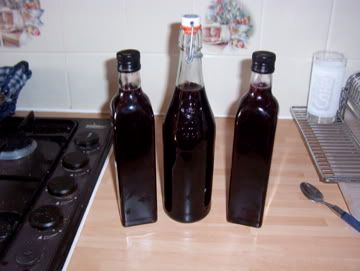
ELDERBERRY CORDIAL

Photobucket - Video and Image Hosting


If you have an elderberry tree in your garden you might find it full of clusters of berries. They are ripe when they hang down. The recipe I followed is simple but I added some cinnamon to it ( just because I am partial to that).If you want the recipe, leave me a comment and I will send you an email about it.

The use of elderberry cordial is to sooth coughs and colds in winter and in a way it makes sense when looking at the plant and the clusters of flowers as they look like the bronchiae part of lungs ( for those of you interestesd in the shape of things). Plants have many uses.

Elderberry flowers make good cordial early in the spring time, the leaves can be used as a dye for yarn and apparently the branches were used to make flutes and other musical instruments. It grows like a weed in my garden, but at least its a product I can make use of.

Orange burst


Photobucket - Video and Image Hosting


Aren't these colours to die for? Its a windy day today, raining and really an indoor day. Taking some scissors, I gathered a small bouquet of flowers ( before the wind destroys them). The flowers you can see are zinnia and sunflowers, the little orange flower is a favourite of mine and is called Tithonia.

Friday, September 01, 2006

AUGUST HARVEST TALLY

The garden has yielded the following over the month of August :
  • 7lbs Courgettes
  • 21 lbs Apples
  • 6lbs Plums
  • 35lbs tomatoes
  • 5 cucumbers
  • 6 lbs french beans
  • 6 onions
  • 6 lbs runner beans
  • 2 peppers
  • 9 lbs blackberries
  • 52 lbs potatoes


That is a staggering total over 140lbs of fruit and vegetables. The amount of tomatoes is overwhelming from 8 plants though so may want to reduce the amount of plants next year.
I am still only growing for our own consumption and canning for winter use. The french beans I love have not been that successful seeing that I did 4 rows of sowings at various times, march, april and july. Its a learning curve. I used no fertilisers at all on the soil apart from compost.
I am planning on planting green manure in the beds to increase nutrients in the soil as I am not very good at growing cabbages. I can grow the seedlings, but overall the cabbage butterflies and their larvae eat more of the greens than I do.
What is nearly ready is some borlotti beans, they look great but I am as yet unsure what to do with them.

Thursday, August 31, 2006

DE JUNKING INCOMING MAIL

In order to dejunk your life from unwanted calls, faxes, email messages, silent calls etc, you can register your preference with this service. Its very busy at the moment so that can only mean that many of you are already actioning this. The reasons for reducing junk mail are :
  • if the post comes you will not be looking through so much,
  • you will not then need to recycle paper
  • you will save your muscles carrying the recycling box
  • you will save time

A few minutes now could save you many hours during the next 5 years.

ROASTED TOMATOE BASE


If you have a glut of tomatoes at the moment, you could try this roasted tomato base:

Cut tomatoes in half and put face up, next to eachother in a shallow roasting dish. Add a few sliced onions and cloves of garlic. Pour over olive oil and season with salt and black pepper.
Roast in the oven at 190 degrees until the juice runs out. Slightly charred is good too. Sieve to get rid of seeds. You can reduce this sauce by boiling it for a few minutes.

uses

  • use as pizza base
  • Simple pasta sauce - add shredded basil, mix and serve with parmesan
  • Tomatoe soup- add equal quantity of stock to tomatoe puree, and 3 tablespoons of cooked rice, some cream if you want to, whizz together and voila, another tomatoe soup.

I freeze all of the above for use during the winter.

Wednesday, August 30, 2006

Autumn announces itself


The autumn season annoucnes itself a little early I guess this year. The harvest spiders are coming in, a sure sign that the season is getting cooler.
Today, I have continued to can 14 jars of plum jelly, a gift from a neighbour. Sufficient to say that we will be OK for plum jam over the next year. Still, just blackberries to go and we are fixed for jam.

By the way, I am not keen on spiders.

ENERGY UPDATE

At the end of the summer, we usually have a look at what our goals were at the beginning of the year and see what still needs sorting before the end of the year is whizzing by. Our main goals this year related to changing the ways in which we used energy, improving what we could and make changes where possible.
LIGHTING

In the beginning of the year, we switched some lightbulbs to energy efficient ones, and although the costs of the bulbs was quite high, they are not needed to be replaced that often and have a reduced energy requirement to run. My Dh was not keen on replacing all of them at once, but having already changed the kitchen bulbs twice since installing one set in the dining room, he has been persuaded. On my list remains the spotlights in the kitchen. We kept normal bulbs in areas where an immediate light response is required such as halls and stairways but all rooms have energy efficient bulbs in for the main lighting and some for side lights too. This will complete the light-bulb changes possible in our home. If you need some info check ban the bulb.

INSULATION

Increasing your insulation by putting a sweater on works well when it gets cold, so putting more layers into your home also makes sense. The amounts of insulation recommended has increased over the years and there are some grants available to enable this work to be carried out. Check the energy savings trust website for good ideas and availability of grants in your area. We have increased insulation in our home and I look forward to a warmer winter and a cut in energy bills.

HEATING
Whatever source of heat you use when the weather gets cold, check out how it compares. Our house did not have central heating although we are in the process of having that done. Certain heating boilers currently are more energy efficient, so if you have no heating, again, check what is available in your area. The energy savings trust provides a variety of info on the matter. When you use heating, you can keep the temperature at a comfortable level, use temperature controlled radiators for each room and use your common sense. Again, this will vary from person to person, the common sense and the temperature you want in your home. We did not suffer the cold for more than 2 weeks per year and used to wear sweaters, warm socks and drink plenty of hot drinks to keep us warm in the mid bleak winter.

DOUBLE GLAZED WINDOWS
If you have none of that, it will help to keep the heat in and the cold out. Leaky, draughty windows...been there....

ENERGY SUPPLIERS

The costs of energy suppliers is going up and there is some variation in the costs per unit. Check with uswitch to see if you have the best deal available in your area. Also worth asking your supplier what deals they have should you want to stay with them.

APPLIANCES
This is an area we are continuing to work on. We have appliances in the home and in order to reduce the amount of energy we use we can ask ourselves, in what way this mechanised and electric machine is going to make our life easier and whether pure muscle power could do the same. When an item breaks, check whether your life depends on it, such as toasters, kettles, hairdryers, timers, clocks, radios, tv, washing machines, tumble dryers, dishwashers, freezers. All of these either are essential to your way of life or not. Its not up to me to say what is and what is not in your life, but being aware of alternative ways and the costs involved may help you make different choices. We have an 8 year old dishwasher but when it goes, it will probably not be replaced. A dishwasher has meant we need more crockery and dishwashing tablets mean the cost of a load is 50 p per wash. A personal choice that depends on the amount of people in your home. With 5 of us, it makes sense sometimes but we could as easily wash by hand.

GENERATING ENERGY
One of the plans we have is to look as to whether we invest in solar energy on our south-facing house. I balance this up every time it enters in my awareness and although I realise that we are never going to make enough energy for our current needs with 5 people, if we continue to reduce the amount we use and increase the amount we produce, we will eventually meet in the middle. Solar power for electricity will be a project to look at seriously and explore further in the months to come.

TRANSPORT COSTS
Again a work in progress, we have 2 cars as mentioned before and we make choices. We no longer travel by plane and are looking at the viability of public transport which in a rural area is limited. You still need to have plenty of time to make that happen. Instead we plan better use of our cars and journeys which is working well so far.

Sunday, August 27, 2006

The DAILY LOAF - whats in yours?

To tell the truth, we used to eat pappy bread. That is until one day, I packed it on my bicycle with an elastic to keep it tight and found out that most of it was air and chalk. Not good. It has however taken a few years to change the daily habit of pappy bread to a nice crisp french loaf which is still being made in the breadmachine as well as granary, wholemeal and brown bread which are made by hand as well. Its a transition and I have gone through the brick stage as well, the loaf with holes in the middle, the collapsed one as I left it to rise too high etc etc, but never a dull moment with the production of the daily loaf. It needs very little actually, flour, yeast, water but even breadmachines need to have sugar and salt and yeast to make it happen within the small space and timelimits imposed and exact temperatures. Its scary to read what is finding its way in your daily loaf these days in order to keep it looking fresh, tasty and well....artificial. Read more here and please have a go at making bread, it does not take that long, the time is in the rising and waiting around and I know....you do not have the time. Even if you make a loaf at the weekend when you do have time, you will learn a valuable skill and it may even exercise the muscles you have overused typing away or clenching the steering wheel whilst commuting. Bread.....hmmm...its not only the taste for me but the heavenly smell that permeates the house and the sound of boys who tuck into a doorstop sandwich.( actually its probably one of the times they are quiet and peaceful as chewing takes their attention away)

Saturday, August 26, 2006

planning a journey

One of our cars has a flat tyre again. ( yep we still have 2 cars...as we are trying to reduce the impact of chucking one of the scrapheap). We make a choice on length of journey, fuel consumption and nature of the journey to choose a vehicle. Both are over 4 years old now, one is a petrol engine estate care ( good for trips involving carriage of items) and we travel 5 people in a small medium family car which is more fuel effective but has no space for luggage. This week we will be trying to manage with just one car and adapt accordingly.
The cost of the cars is limited to running costs as we do not have any loans on the cars. But as fuel prices increase we are looking at alternatives. The budget limitation on fuel is tight and as prices increase we have to make different choices.

Some of the things we have changed so far :
limit shopping journeys from once weekly to a once a month home delivery and online order.
making a list of items that we need and plan shopping around other essential journeys.
Use our local food producers and growing our won food ( no food miles).
using the best mode of transport based on economy, amounts of people/ luggage, distance.
Check out alternatives.
Give up on flying to far away destinations.

2 of our family members are limited in mobility which makes long walks difficult.
One excellent resource online is the travel planner which allows you to make a comparison on cost, time and best route to take. Now with 5 people going by car is often the cheapest and quickest route to take but it is worth looking at other alternatives just so you know why you are choosing to take the care, bus, train etc.

Friday, August 25, 2006

Organizing your bedlinen

Still decluttering, this time we focussed on the bedlinen in our house. Needless to say we have enough to run a hotel. How much do you really need? This simple formula will make laundry day and changing sheets a lot easier.
Spare bedsets to be kept in each bedroom. When washed store the whole dry set in one of the pillowcases and store. When you need a sheet, duvet cover and pillows, it will all be to hand. Makes it handy when kids throw up in the night, just dig deep in the drawer and voila your next set is ready and lined up. ( If you are like me, you are not at your best at 3 am to try and find a set of bedcovers).


For adult bed, one set on and one in the wash.
For children above 8 years old - same as adults
Children 3 to 8 need 3 sets each.
babies and toddlers need 4 sets each plus waterproof covering for mattresses.

This left us with 5 sets with no home, well we freecycled them and some will be used as backing for quilts when I get around to making that.


Thursday, August 24, 2006

A video about Path to Freedom

If you want to see what can be achieved on a small plot, take a look around at the treehugger video of Path to Freedom, always good to see folk actually doing well working with their hands, and reducing their energy needs.


Wednesday, August 23, 2006

On poverty

As far as the government statistics are concerned, we live in poverty. Its devastating to know that. Well, I mean, we do not have the luxury of other people to go on holiday, to consume whatever takes their fancy and yes we do have to think before we spend out on things. We cannot purchase take out’s, we cannot go and enjoy leisure activities, we hire our games instead of buying them, and we have cut down on eating meat. We do not go shopping on a regular basis etc etc...you get the picture.
However, we do have time as a family, we talk, we eat together, we learn skills, we spend time in the garden, go for walks, wonder at the earth and the beauty, look at thunder storms and lightning, enjoy conversation, go for picnics on the beach, build birdhouses out of scrap wood, pick apples and plums, enjoy fresh eggs from our chickens, turn over compost heaps, watch lettuce grow, learn about plants and food stuff as we grow it, care for our animals and ourselves, and sleep peacefully at night. We may fulfill a government statistic that we live in poverty...but in many ways we are enriched by the experience we are living. And then there is always bread and jam..........

The point is that it is questionable how we, in the west, whose main needs are satisfied every day, can be considered living in poverty when there is actual poverty in the world, where children starve, have no fresh water, have no roof over their heads, or their parents are ill, the crops do not grow, through either a drought or war. We may live in considerable financial poverty compared to the ‘ consumer norm’ but we still find enough resources to sponsor a child in Bangladesh..... And then, there will be candles at the table, fresh soap to wash with, nice apples to eat, without any chemicals, fresh water to drink, great conversation and the enjoyment of being a family member can bring. Its a smaller life as far as statistics are concerned, but a much bigger life experience making smaller footprints on the earth and making a bigger impression on the lives of our children.

Money we may be short of, but thats probably the only thing we are short on compared to other people, time we have plenty of and we still have time for each-other.

bread and jam

One of the food items people in this household will not go without next year is bread and jam, the staple of our lives. the cupboards are filling nicely and if there is a crisis there will always be bread and jam.
I am reading a book on Optimum Nutritrion in which bread and jam would figure badly. There were however some interesting pointers that I thought could be incorporated. The message of the book is that every human being has different nutritional needs depending on genetics, environment, culture etc but that all of us have some things in common that need to be supplied. The diseases currently surfacing are not just new diseases but are the result of not having the optimum nutrition required for our bodies.
Easy things you can do without changing too much:
  1. one heaped teaspoon of ground seeds or one tablespoon of cold-pressed oil ( omega oils)
  2. Two servings of beans, lentils, quinoa, tofu, or seed vegetables
  3. three pieces of fresh fruit such as apples, pears, bananas, berries, melon or citrus fruits.
  4. 4 servings of whole grains such as brown rice, millet, rye, oats, wholewheat, corn, quinoa as cereal, breads and pasta.
  5. 5 servings of dark green leafy and root vegetables such as watercress, carrots, sweet potatoes, broccoli, spinach, green beans, peas and peppers.
  6. 6 glasses of water, diluted juices, herb and fruit teas.
  7. eat whole organic, raw food as often as possible
  8. supplement your diet with high strength multivitamin and mineral preparationand 1000-mg of vitamin C
  9. avoid burnt and browned food, hydrogenated fat and excess animal fat.
  10. avoid any form of sugar, also white, refined and processed food with chemical additives, and minimise intake of alcohol, coffee and tea. have no more than 1 unit of alcohol a day ( i.e. one glass of wine).

Thats probably enough to get you thinking. Its a good book, very scientific so can only be read in stages. Food as we buy it in the shops however has not got the amount of nutrients we need, and that is why we supplement with sweet foods which give us an energy boost but it is not good for our bodies.

Changes I have made as a result is adding some seeds to my cereal and granola, eat more berries and try out some other grains that I had not heard of. The green leafy vegetables are not an issue because we grow them anyhow. There is a general reduction in our household in meat eating...but then again, you cannot change people’s eating habits over night it needs to be done gradually.

Sunday, August 20, 2006

Working hard for your supper

The work ethic is continuing in the house. Dh is painting a bedroom with the assistance of 2 boys. One was asked to put masking tape around the plugs and they all went off, got changed into ‘ work clothes’. The day was a busy one. DS 1, in charge of all techno things, updated and swapped technology and they continued negotations on what was necessary. In the meantime, I picked some tomatoes and brought some eggs to a neighbour. I returned with a box of apples and some freshly picked sweetcorn. The secret of sweetcorn is that the sugar turns to starch the older they are so they were on the menu at lunchtime. I made 6 quarts of apple sauce, then boiled up the sweetcorn and we sat down all together enjoying a hearty lunch and counting our blessings.
The boys really worked hard all day in the house, painting, sorting and playing with trains in the lounge. In the evening, I picked some salad leaves and we had a stone baked pizza with salad followed by a plum tart with yoghurt. It all felt like a hard days work but very satisfying.

On a garden note, I am planning the salad leaves for the autumn and winter, merveilles des quartre saisons, rocket and mizuna.

Friday, August 18, 2006

Changing rooms

It all started out with my DD moving into her very first flat and de-cluttering her home. In the city it is often difficult to get rid of accumulated stuff, and with no car it almost seems impossible to deal with things on a timeline. We took the stuff home, and found some other homes for things, some things we adopted and others we did not but all in all it was interesting to see the next step. My boys decided they too would move, not house, but would de-clutter their stuff ( does this ever end, we have been downsizing stuff for 12 months now!). They will be changing rooms, sharing with a different brother which means that stuff needs sorting, recycling, selling, free-cycling etc. I wonder where they get their ideas from, might it be that our downsizing efforts and tactics are filtering through. yes, you can live with less stuff. One of the boys bagged up about 15 teddies and soft toys and although a part of him hankers after holding on to some of it, another part of him says it is no longer going to be cool to have that many softies around. Toys they have not played with for years are being rediscovered while they clear stuff. So now, instead of being in front of the play-station, they have turned the lounge into a giant brio trainset with complicated tracks and bridges they have just newly rediscovered. The duplo they gave a miss but trains and cars are hard to part with. The dog was less convinced and caused a major catastrophe by falling onto the bridge ( simply stretching its legs). The dog was given ‘ time out’ and they resumed their game, with trains.
Another interesting development was the asking ‘ can I have an apple’ instead of the usual sweets, crisps etc that were found in the larder. And then there was a strange look when they were banished from the foodfactory back to the railway game. Life certainly has changed. One thing I would like to see them change is the ability to make every room in the house in the flux of change. Their stuff now dons the landing, both rooms, the lounge and even the bathroom. I keep reminding myself its the process that counts, a smaller life, with more space, more fun and community. Ah and the communication for working together also needs a little tweaking. On day one there was a lot of shouting, day two less shouting and stomping off. It feels like bootcamp but I do think they are having fun by the way and it sure beats the cues in airports and the eco costs of holidays. Who would have thought you could have so much adventure in your own backyard. The team have gone to bed in different rooms ( just trying it for size) and I guess some negotiation will continue to happen but thats good, when they are talking to eachother and learning to talk and use eye contact, at least they are not trying to kill someone in a game. I am keeping my fingers crossed, my hopes high and look at the growing that is taking place.

HARVESTING TOMATOES

A recent visitor asked what it was that I had fed my tomatoes on as the vines are positively dripping with fruits. I did not actually feed them but made sure that the soil was healthy. I do a rotation of potatoes, beans, salad, tomatoes,courgette and cucumber then salads again. Each time I plant the potatoes and tomatoes I add some compost to the soil. Regular watering also enables the plants to grow well as well as taking out the sideshoots and stopping the plants when 4 trusses have formed.
This basket is the first harvest from about 8 plants and was 15lbs in weight. Some of them have been frozen and 6lbs became spicy tomatoe chutney. Last year the 6 jars made, just dissappeared too fast in winter. We also had roast tomatoe soup for lunch with some homemade ciabatta.
Today, my bartering partner arrived with 21 lbs of plums in exchange for the tomatoe plants and other nursery plants I had given them at the beginning of the season, so I guess I shall be busy canning those today. Yeah. Practice makes perfect.

Now, I cannot say that this type of lifestyle is easier than going to the supermarket but it is more satisfying and interesting thats for sure.

Its simple to make things difficult, but it is difficult to make things simple.

Canning peaches

The first batch was a lovely experience. The kitchen has stopped being a kitchen and has turned into a food factory where preserving the harvest has become a daily occupation. I am not certain that the peaches are meant to be floating at the top, but it may have to do with too much air in the jar or a condension of peaches, who knows. What matters is that I managed the process and am looking at the start of a fullish pantry.

Monday, August 14, 2006

Avian Flu

Someone kindly asked by leaving a comment whether Avian Flu was going to be a problem. Here in the UK I follow the advice of the NFU and follow the guidelines should I find 3 or more dead birds. My chickens are in a coop that is partially covered and they are locked at night to ensure that the fox cannot eat them for dinner. I cannot protect them much from wild bird droppings because there are pheasants in this area and wild geese fly overhead. The key for me is to keep my small kids away from poultry, have impeccable hygiene as far as the water canister and food supply goes. If your animals are healthy and you look after their welfare then that is all you can do I believe. If avian flu hits the area, then we will have to do what we are advised to do, but in the meantime, I care for them as best as I can following the guidelines provided. For the USA info can be found here on what is happening worldwide.

The strangest thing in this country is that they have a sheep, cattle and pig register and also want owners of flocks of more than 50 chickens to be registered. All animals in this country should be able to be traced by tags and numbers. On the other hand, they are able to lay astray, illegal immigrants and escaped prisoners...which to me seems a little ironic.

Friday, August 11, 2006

Fishy Business

My oldest boy and his friend went mackerell fishing yesterday and brought home a dozen as victorious hunter gatherers. Hmm....what to do with them now?
I have a good library and had seen someone gutting and filleting a fish so the only thing was to get real and do it myself. Its true, you need sharp knives, plenty of newspaper, then keep the cats at bay, boys out of the kitchen and then get on with the gruesome business. It is not as pleasant as canning I have to say, but dinner is sorted anyhow and it will be lovely for the boys to eat what they caught for supper. That experience is not for sale in the supermarket. Ok it was messy, I was clumsy with it, but I am sure the end result could not be fresher. I am enjoying this after all...thats what I keep telling myself.

Thursday, August 10, 2006

Zuchini pickles

After the jars arrived I thought I would practice canning something using the water canner and opted for ingredients that were to hand, small quantity ( in case it went wrong) and got everything ready. Actually, the kitchen looked like a laboratory, a food factory and I donned my apron and banished everyone to the outer boundaries of the house. Cries of ‘ mother is experimenting’ went on in the distance and small people occasionally gathered at the door to test my patience, check my mood, frustration and anything else they might wish to spot. What they saw was a carefully planned, executed canning operation with the resulting 4 small jars ready and waiting after the canning operation.
I still have a vision of rows of canned produce, hopefully in sterilised jars with no bacteria showing through because a mouldy cupboard would just about make me come out in tears and screams. I am hopeful, I followed the instructions, used a thermometer to check that it had reached sterilisation temperature and I have survived with 4 jars to show for it.
At this point I am tempted to say, well I could as easily go to the supermarket and buy the stuff but that is hardly the point. I wanted to make the transition of growing our own veg and fruit, creating a larder of canned convenience foods and be independent from the middle man, less trips to the stores, less fuel used etc etc. I am holding on to that vision.

The enthousiasm and success of 1 afternoon in my kitchen food factory have not killed my wish to continue. Awaiting ripening a little are 2 boxes of fresh peaches, my boys have a jobs scheduled to go and pick my neighbours apples and I am waiting for the plum harvest. Guess I will be busier than I want soon but then in the winter I will be able to hibernate, put my feet up and enjoy the fruits of my labour. In principle. At least my survival does as yet not depend on my canning activities, if I really mess up I still have the fail safe plan that I can, if needed go to the store............I sincerely hope I will not have to do that but its always nice to know that I can and yes, I can can now. Heavens have managed to add another skill to my portfolio......guess there is not much call for it yet. Just you wait, canning will be in again soon. I am running ahead of a new trend.

Tuesday, August 08, 2006

Time away

You are probably wondering where I went off, or then again I may be flattering myself that you have given me a thought at all. Its been a daily round of gathering, cooking and preserving in this household as well as picnics to the beach and family time. Summer seems to be here forever, it has a lovely feel to it, as if summer in the UK always has been like this, which in fact this year is an exception. There is a need to be vigilant for mildew and trying to plant some more seeds so that the vegetables and fruit continues in the harvesting months.
The shipment from Lehmans with canning equipment came yesterday which was an exciting event. It will be even nicer when the larder boasts rows of jars with produce to be eaten during the colder months. The anticipation of that made me clean some more shelves and get rid of some more clutter. Seems endless the accumulation of stuff.
I realise that when I spin the fleece of a sheep, turn it into yarn, then knit a sweater with it, that I value the product I have made because I had some part in its journey from resource to product. The end result is pleasing and it reminds me that the garment is unique and priceless because it just cannot be mass produced. It is made to fit and I value the journey I have taken with the resources I was given. I think my generation has lost sight of that. A cheap T-shirt or other stuff I accumulated in the past,does not have that connection and if I knew when buying some clothing that some woman was being paid less than the cost of living to produce it, I may think twice about buying it. Growing fruit and vegetables, making food from scratch and not adding to the consumerism is not an easy road to take......it is not a simpler life, in fact it is a harder road to walk, with the knowledge that I am going to need to learn skills, that I am going to have a glut of some things and that bugs are eating my cabbages. At least there are butterflies.....they symbolise a freedom and if by not buying a cheap T-shirt, I stop one child from having to work under slavery conditions, then that too is worth it. I can do without another , I can do without violence, I am no longer prepared to pay for that. I can be an ethical consumer yes, but it is going to be costly, in fact the way we consume is consuming the earth and you may say that one person cannot make a difference, but stopping the urge to continue consuming may be a step worth taking.

Wednesday, August 02, 2006

GIANT CUKE

Deep in the magic bean forest, overlooked for many days, a cucumber grew quietly benefiting from the heatwave. Today, while it as a little cooler, I walked in to find a 3lb cucumber hanging in between the greenery. I harvest every day and despite looking very carefully I miss quite a bit really, a marrow as well. Todays harvest is
1lb green beans
1 marrow
4lbs cucumber
5 onions
3 apples
1 lb courgettes

So we will be having courgette soup for lunch with crusty bread, tonights salad is salade nicoise with fresh tomatoes, home produced eggs, some green beans and salad, what is not from the garden will be the tuna and dressing. That feels so great to do. To drink will be a vegetable juice from cucumber, lime and carrot which promises to be very refreshing. All I need to get on with is the fresh bread rolls.