Sunday, October 21, 2007

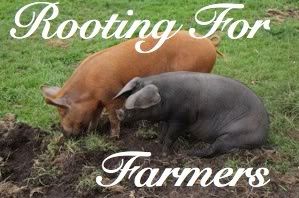
ROOTING FOR FARMERS

A blog award in support of farmers worldwide:


Rooting is the process of putting forth roots and beginning to grow

I have received a few blogging awards recently and I would like to sow a blogger
award into the world, one that is given to bloggers who are using social media to unite, inspire and sustain local farmers and farming.

The rules to show your support:

Tag your post if possible with ‘rooting for farmers’ and lets raise the moral of farmers in the community.


The rules are :

1. Write a post about what farming, farmers and local food mean to you.
2. Nominate three bloggers who epitomise "Rooting for farmers "


3 .Link back to the person who nominated you, and link back to this post


4. When you receive the award, you may display the "Rooting for farmers" button on your blog by pasting the HTML Code listed below on your blog.


So here goes:

My nominations go to
Heather from around the world in 80 megabytes

Neil from the Gastrocast
http://gastrocasttv.com//blog/

Farmer Jake

and a special award and thanks to Mark from The Green Fingered Photographer:
who generously gave his permission to use the pig picture.

HTML Code For The Button

<a href="http://downshiftingpath.blogspot.com/2007/10/rooting
-for-farmers.html">
<img src="http://i39.photobucket.com/albums/e169/sockknittingmama
/SupportForFarmers-1.jpg" border="0" height="60%" width="60%" />
</a>


Saturday, October 20, 2007

The coal house - living in 1927 in Wales

BBC Wales are scheduling a historical programme over the next 3 weeks where 3 families will return to 1927 and live in 3 miners cottages as families of that time.
The families will have to work together, the women and children during the day while the men are working 8 hours, underground in the coal mines. There will be no heating, no computers, no washing machines and a garden with some vegetables like curly cale, parsnip etc. This programme will not only show the hardship in that period of history but might give us an indication of what life could be like without electricity and fossil fuels easily accessible. The men will be paid by the amount of coal they haul up which will determine the food on the table.
What I noticed was the lack of stuff they have and the space limitation. Families will each have the same amount of space, 2 rooms down and 2 rooms up and one family has 6 children including baby and toddler. The programme can be accessed on BBC Wales. You can look at some pictures about the coalhouse here.

In the meantime, Kate Rusby's song about my young man shows you some pictures of coalmining and set the scene. Communities were destroyed in the 1980's when a large proportion of coal mines shut down a fate not dissimilar to what is happening in the farming and manufacturing in the UK.

Apple day

Apples have a real significance in my family, you see the photo above shows my great grandmother on the left who was known as ' BonneMaman Popomme' because she lived in a lovely rambling house in the countryside with many apple trees and willows. I did not have an awful long time there by my mother remembers it with great fondness, not only the person but also the place. I know that when my mother visits here she feels a kinship with the landscape and it comforts her in some way.

One of the crops we grow really well locally are apples. Somerset is well known as ' zider country' and in reality there are a lot of orchards ( long gone) but gardens usually boast a tree or two of familiar varieties.

Yesterday, my neighbour, who knows that I have a penchant for apples and great produce, brought me ' la belle de boscoop' apple. Little did she know what memories this would bring back. I have no doubt it never made it on the supermarket shelves as it is one giant apple, next to the Cox and Egremont Russet in the picture above. I love the names of apple varieties.

On 21st October 2007, it will be apple day and many events will take place all over the country where you can go and explore varieties to tame and tickle your tastebuds, as well as find local producers who grow these in magnificent orchards. Many orchards are disappearing and to help you find a local one in your area you can use this locator map with news of what is 'appling' in your area. A great resource for local food including local recipes.This is my version of a simple victoria sponge traybake with diced apples on the top. Bake as usual but dust in caster sugar. Can be eaten hot with cream, custard, ice cream, yoghurt or the next day as a cake, if it lasts.....

Our village celebrates a wassail in January and through the website I discovered a community orchard I will go and visit with the children.

To keep the cider farms going, find one near you, buy some and raise a glass to the sweet taste of apples.

An apple a day, keeps the doctor away.

Even if I knew that tomorrow the world would go to pieces, I would still plant my apple tree.”
Martin Luther

Friday, October 19, 2007

Farmers - an endangered species


It continues to be in my awareness and there have been some excellent contributions from Farmer Phil, Podchef and Heather in the comments section, please go and read them.

Heather in particular offers the following suggestions :

Heather's draft guide for cheering up farming:
1: Think about the food you are eating - not just the posh restaurant meal on the weekend but the cake in Starbucks and the food in your freezer. Check out the yogurt in your fridge and where its practical start to source it locally and sustainably from farmers.
2: When you do use a supermarket - try to use Waitrose - they are the best at sourcing local sustainable produce from Farmers in LEAF.
3: Blog about it all, blog blog blog. Phone up the Wiggly Podcast and leave a message of support - or a rant 00441981 500930. We'll play it to the world. Come on the show - email me heather@wigglywigglers.co.uk, get involved with this www.heathergorringe.com
4: Ask a farmer to come and speak at your school or organise a farm visit. Check out the Year of Food and Farming
5: Get informed - it was the government research place that spread Foot and Mouth and other European countries have Blue Tongue and they dont shut down massive areas of farmland!
6: Grow things of your own (I know a really good mail order company that sells farm produced hedging, veggie seeds - birdfood all sorts...!)
There's a start anyway.

It is going to be mighty inconvenient to do this.........most people are going to say that they are too busy, not enough time= not enough money, what is the cost going to be?

If you grow fruit and vegetables in your garden you know how much work it takes and also the pleasure you have from eating something that is fresh, local and hopefully as organic as possible.

DH is in the process of starting a business venture in our local community but just like farmers, it seems to take ages because we need to have this and that certificate, go on this and that course and comply with this and that legislation. There is in principle nothing wrong with protecting the consumer but even at this level I keep asking myself, should we bother. Every course, every certificate gains you what exactly? I am not knocking it, it just seems that every step involves us paying a fee to an agency to put a stamp on what is mostly common sense. I guess it is the same with farmers.

The Uk has some of the most fantastic countryside, sheep eating the grass in the hills act as stewards to the countryside too, without them, land could go to what exactly?

What you can do easily to get an idea of a farmer's life :
Listen to Farming Today to get a flavour of what is happening and how real the situation is.
Go and source local ingredients and cook with what is in season.
Check out the Farming Help Appeal 2007 site for details.

Most of all, engage with what is happening and whatever level you can.

Thursday, October 18, 2007

Quince, the golden apple


Having been given some quinces last week and enjoyed their decorative value in the fruitbasket, time came to make them into something useful, pretty and edible.

People say that for the Greeks and Romans, quinces were the golden apples of Hesperides, the golden apples that prevented Atalanta winning the race. The quince was the golden apple that Paris awarded Aphrodite- which is very suitable as it was after all her fruit. The fruit of love, marriage and fertility. This is the scent in spring of the beginning of love. There are more references to quinces and love such as in the poem written by Shafer ben Utman al -Mustafi in 982.

It is yellow in colour, as if it wore a daffodil
tunic, and it smells like musk, a penetrating smell.
It has perfume of a loved woman and the same
hardness of heart, but it has the colour of the
impassioned and scrawny lover.
( extract)

And you can imagine the quince being the fruit in the story of the three golden apples.

Its a fruit with history, myth and its colour and perfume delight if you can see past the hard and unattractive shell.

There are very few recipes about what to do with quinces in english recipes but I imagine there may be quite some recipes in Persian and mediteranean cuisine. I have started with making quince jelly and delighted at the salmon pale colour of the flesh and the rich clear liquid that boiled up made an exquisite jelly. If you have access to a lot of quinces you could make membrilo and quince paste which goes well with cheese. Its a long stir and watching over the pot to ensure that it does not burn in the bottom of the pan but makes an excellent Christmas present in a pretty box.

Wednesday, October 17, 2007

The farmer- an endangered species?

Hill Top Farm by David Knowlton
Hill Top Farm


The farmers need to know that they are valued. The story about the sheep being culled and low prices for crops is likely to pass many by and yet it is an indication that things are not right.I am very fond of my food and interested in where it comes from, add to that a passion about fibre and sheep, living in the countryside and I am at a loss to grasp what is going on and how we can help the situation.

A lot of DH's friends have tried to make a living as farmers and a large proportion have either retrained in other trades ( plumbers) or their marriages have broken up due to financial pressures. Statistically too, I understand that the suicide rate amongst farmers is higher than average.

I grew up in a city, with a lot of concrete and parks and yet was unaware that milk came from cows. We did have independent shops in which you could purchase food of which you could trace its origin, local food prevailed and there was a pride in farmers. My childhood holidays were spent on a dairy farm in Germany where I loved helping out , sitting on the tractor and learning about what grew where. Over the years we have seen small shops disappear and supermarkets take their place for our convenience.

2 years ago, the WI campaigned to raise awareness of the price difference between the price paid in the shops and the price paid to the farmer. This was followed by a marked exodus of dairy farmers, as I understand mostly those who rented farms and were faced with higher interest payments against lower income. Farmer's wives went out to work to earn extra money and many farmer's families live a poor existence. Others may look rich in land that gets sold off to produce more housing estates. Gradually, the land that produces food and sustains us is changing.

Again, does it matter?

Not if you want to continue shopping in supermarkets, if you want to depend on other countries supplying our resources and not it you are comfortable with what is going on.
Personallly I have found it inconvenient to stop shopping in supermarkets and to search out local suppliers, farmers markets and to change my eating habits to a more local scene and yet, at this harvest time when we are thankful for the harvest and for a variety of reasons, tins of baked beans and tomatoes are brought up as thanksgiving offerings, I shudder somewhere.........

A very sad picture emerges in my mind of hens in cages waiting for their food to be be dropped in, so they can lay an egg in cramped conditions...what is the difference between them and us? How long before we are in small cages, go out to work to earn money to provide our basic foods because they are imported from far away?

At harvest time, go out and seek out a farmer, wave to him when he is on his tractor, buy him a drink in your local pub, make a point of telling him/her that you appreciate what he is doing. Ask questions, find out what is happening in his world. Winter is a long time, a lean time this year for many farmers in isolation, if we cannot change the immediate picture, let us at least reach out and show them we care about them and the work they do.


The Green Governor comes to school

Edge of Exmoor, Near Porlock, Somerset, England, United Kingdom by Rob Cousins
Edge of Exmoor, Near Porlock, Somerset, England, United Kingdom


A few weeks ago I was chosen to be the Green Governor for our local primary schools with a remit to look at ways the schools impact on the environment and to share possibilities and discussions with the children about the environment. Sounds daunting.......not really as we have been living it for the last 3 years, it seemed to me that I could finally contribute on a level that I felt reasonably competent in.

Two weeks ago a date was arranged and I had planned my activity with the helpful suggestions of Richard from WigglyWigglers. Having collected 2 weeks worth of recyclable materials, a few plastic bags, egg boxes and a load of rubbish, having washed it thoroughly , I arrived with a box full of stuff. It was raining.My youngest son did all he could to reassure me that it would be ' cool' and that I would probably not bore them to death. Gentle river sounds acted as background music in the room as about 30 children gathered and eyed me up. I told them I was passionate about the countryside and was going to tell them all about rubbish. After all we live in a fantastically beautiful part of the UK where many people come on holiday, walk in the hills in an area of outstanding beauty.

Last week the children enjoyed a woodland walk and bringing back the nice feelings about the woodland I asked them how they would feel if someone would come into the woodland and empty a bag, just like this........

The teacher's face was a bit shocked as I emptied a large black bin liner full of 'washed' containers, papers and plastic bottles onto the floor. The children's emotions ranged from sad to very angry. I also had asked 2 children to bring their lunchboxes in and after opening to pass it to each other from which they ascertained that it was not pleasant to deal with other people's rubbish.

Often we believe that children do not know what happens in the world but they convinced me that they not only took the environment seriously but that they wanted to know what happens to rubbish when the men pick it up. Surprised reactions when told that it is dumped in a landfill site. What could they do?

Three words - reduce, reuse and recycle :

Some suggestions on what to do with yoghurt pots were planting seeds in them, using them as paint pots, keeping small treasures in them.

The trays that are used for packing vegetables and meats in could be used to sort items in your wardrobe, keep jewellery in, plant seeds.

They had however never heard of the natural rubbish eaters....those wonderful wiggly crawlies that eat a variety of materials and turn it into compost.

I do believe that in 30 mins I managed to convince them that rubbish is worth talking about.At the end of the talk, my youngest son stood up and showed them his favourite glass which has sensible suggestions on such as :
walk more
put rubbish in bins
respect wildlife areas

The next step is for the children in the school council to discuss how the rubbish generated at the school can be processed and how they can obtain a wormery. I can't wait!

Tuesday, October 16, 2007

All at sea

We are at that stage in house negotiations where you stand at the end of a cliff and you cross your fingers that all will go ahead in the full knowledge that it might all collapse and you end up where you started, which in our case is a lovely cottage. I dislike uncertainty I have discovered, I can stand some of it but not if it goes on for months.

On days where I am lost a bit, we go out to the seaside, and on a blustery October day when the tourists are absent, Lyme Regis takes on a different atmosphere. We go about once a year, usually in February and are the only ones eating an ice cream when the temperature outside can make it last forever. Today, DH and I, headed off and I took my camera with me, capturing a variety of sights.


This one caught my attention due to its colour combination which brings ice cream sundaes to mind. Further down the beach, a bit of beach art. Lyme Regis has changed a lot over the last 25 years, all that was missing today was the sunshine, apart from that the magic never fails to bring a smile on my face. Home tired and happy.

And still you have to watch the seagulls as they are after your lunch, but magical to watch as they hover in the wind currents. That's exactly how I feel, hovering on an air current. Fly, Fly.......

Monday, October 15, 2007

Blog Action Day

Earth, view from space by Randy Berg
Earth, view from space

Bloggers Unite - Blog Action Day


The place we call home. It is worth bothering about.

So what is an environment and what are we talking about when we talk about the environment.

Ecosystem (plural ecosystems)
A system formed by an ecological community and its environment that functions as a unit.
The interconnectedness of organisms (plants, animals, microbes) with each other and their environment.

The essence of my blog has been that the steps I take, however small have an impact. For each action there is a counteraction somewhere in the environment.
If you go shopping with a basket you save a plastic bag from use and then being thrown in the landfill.
If you grow your own vegetables and flowers you not only enjoy excellent quality, added wildlife but you can get exercise and brighten up your garden and immediate environment and you stop food travelling miles.
If you use your car less, you reduce the Carbon emissions, you use less fossil fuel and if you are able to cycle or walk you can stay healthy.
If you reuse an item that otherwise would end up in landfill, you use your creativity and make something unique.
If you plant a tree, you add to the earth's lungs and if its an apple tree, not only will you see lovely blossom in the spring but it will reward you with fresh apples later in the season.
If you join your community for a potluck supper, you will find company, enjoyment and merry dancing ( beats a night in front of the TV).
If you buy fair trade, you ensure that a farmer receives a fair wage for the effort they have put in ( at home and abroad).
If you feed the birds and give them water, they might eat your caterpillars.
If you stop using pesticides, caterpillars will multiply and make wonderful butterflies.
If you learn to have less, you will discover more.
What are you waiting for.....there is a world out there to explore.
Most of all remember that we are all in this together.

Saturday, October 13, 2007

There's no place like home- part 3

Home from Home by Sam Toft
Home from Home


“A house is made of walls and beams; a home is built with love and dreams.”

Robyn left a wonderfully thoughtful comment at the end of part 2 upon which I would like to expand.

Hi, the place I called home does not exist any more. We had a woodstove in the kitchen where mother cooked the meals. Mother had to sew clothes because there was little money. We didn't have TV or video games or computers or access to the internet. We had good neighbors and we cared about them. Today my daughter in law has four boys in the home and she stays there with them. Their life is so vastly different, but the one constant is that each home had a caring nuturing environment for children. When children know they are loved, no matter if they are raised by a single parent, they do not seek it in other places.

Parents who "walk the talk" make a difference.
Homes are not just buildings, but places where as children we should be able to safely find our authenticity before we face the big wide world. I say, should, because I am aware that sadly there are too many people whose experience of ' home' has not been and is not a good one, a safe one and who alltogether have a ghastly experience with regards to their shelter.

A shelter is not only a physical structure but also a place of safety, a place to retreat from the world. A place to lick your wounds, a place where you feel accepted, a place where there is a connection. The term retreat has several related meanings, all of which have in common the notion of safety or temporarily removing oneself from one's usual environment. A retreat can be taken for reasons related to spirituality, stress, health, lifestyle, or social or ecological concerns. Home is a place you should be able to retreat to.

Robyn makes the comment that the constant was a nurturing environment, thus home is a place you can go to where you feel loved, appreciated and safe. It could be a seat under a tree.

There is in my mind a difference between a house and a home. I have had that discussion with my DH lately as he looks at the building as a house, the fabric of it ( as estate agents are want to do), and I look at the possibility of making it a home. I love that phrase'at home'. It talks to me about being cozy, about being where I belong, about tending to the parts of my life and people that are the most important. Being at home means savouring the sense of safety and retreat, even when I am working hard. The world can whizz by but inside my home I am safe, tranquil, peaceful and productive.

I grew up with 2 distinct women in my life. A generation who had made a life of being at home and a generation where women went to work outside the home. I believe my grandmothers did not have a choice and made their home their world, my mother did have a choice and went out to work. All women provided me with a sense of belonging and feeling cared for, some were more talented to stay at home than others. I know that my parents loved me and yet their focus was on creating a financially secure home as where my grandmother who had no income of her own, was more successful at nurturing the cozy feel in my life. It would be wrong to say that my parents did not have time for me, because they did, but my grandmother spent her time with me and gave me a very different education, how to make a home. Both have stood me in good stead.


When a house is a home, the people inside it work hard to make you feel ' at home'. What does that conjure up to you?

Add to that the place you call home? Many of us travel the globe in search of employment and have settled in different countries. I started life in Belgium, Germany and England and all these places have added something to what I now call home. When you have all those elements, you express them in the shelter you have, bring them into the fabric of the house you live in and make it a home. Consider the following....where does your soul live?


“A house is a home when it shelters the body and comforts the soul.” Philip Moffitt
Friday, October 12, 2007

Change begins at home


The "Change begins at home" award. This is given to bloggers who live what they preach, who try to make the changes in their own lives that they would like to see in the world and it originates from Bean Sprouts . The rules for this award can be found here. Thank you to the Green Fingered Photographer who nominated me.

My turn to pass it on to :

Mark from Otter Farm
Jane from Yarnstorm
Keri from The Wish Jar


To
walk your talk
is a proverb used by the Native Americans meaning that you put your beliefs into actions.

Thursday, October 11, 2007

Domestic Art


Dear Gaia,

Just wondering if you are OK? The colours in the garden and the light are really lovely but it reminds me more of summer. Is October the new summer? Just asking as I could set my clock by the seasons as a child and now I am wondering trying to remember October. I remember rain, umbrellas and the wind heralding winter time to come. Not that I am complaining, you are creating a lovely landscape, in which the wasps get a bit drunker than usual on ripe fruit and where from time to time we can turn and feel the warmth of the sun on our back. So I went out and harvested some borlotti beans and quinces, walking over the wet grass with my feet, feeling the squidgy grass and creating a still life picture of Domestic Art as inspired by Jane Brocket of yarnstorm. Jane has just published her book The Gentle Art of Domesticity which has received a mix of receptions in the UK. I for one, love what she is writing about, not at all against the feministic movement but showing us that creativity can happen at home using the garden, the kitchen, capturing the colour that surrounds us. So thank you Jane for bringing art and still life back to the fore.

Wednesday, October 10, 2007

There's no place like home- part 2-

Mother's Love by Loren Entz
Mother's Love


Our childhood homes can have a profound and lasting impact on how we choose our shelter and what is important in that. As a child we enter the world having been cocooned and protected ( hopefully) by our mother and we find ourselves in our mother's arms. The world that surrounds us is our home and we explore it with all our senses. Years ago, children were born at home and not in hospitals and I had not understood the impact of that ( apart from healthgrounds) until we left our home 4 years ago to move to the present one. My youngest boy was born at home and his first impressions of home are somewhere imprinted on his soul. When we moved he was bereft. Something we did not quite understand at the time but facing another move where we explored the homes he has known, it became apparent that the home he had been born into had a special imprint. Whenever we pass that house,he can recall the Victorian tiled floors, the wooden bannisters and the way the light shone through the stained windows.

In her book, Spirit of the Home, Jane Alexander explains the symbolic shapes of homes. Houses were roundhouses in the past, where families sat around fires, the centre of the home. The circle is the symbol of the earth, the square is considered to be the symbol of order, stability and control. According to Jane Alexander we started building our homes in squares to impose some order and control over the earth and to make ourselves feel safer. Pointed corners are not as energetically harmonious as round houses. The next symbolic shape is the slanting roof. It points to the sky so that the house sits in between the earth and the sky. A house is always going to mean more than just shelter. It is a structure full of symbolism as well as housing not only our physical bodies but energy we cannot contain and memories that linger in our unconscious. Where we live shapes who we are and how we perceive the world around us.

The closer we live together, the less nature around us, the smaller the living spaces become, the less personal the structure of the house, the more we want to bring our individuality inside. Regardless of space, we have filled it with stuff. We are sold scented candles, telling us our homes are unclean, we have central heating to keep us warm and yet we miss something at some level. We move quickly and rapidly when jobs demand it taking with is whatever possessions we have, leaving memories of other places in another place.

If you observe older gerenations when they leave their home, they take with them heavy furniture, the solidity of what has been their home and identity to enable them to journey on. There is a stability in that that we cannot comprehend. In our house we have 2 items that are more than mere furniture : a piano I was given at the age of 12 and a sideboard that was the ' best' piece of furniture on my DH's parents farm. Just looking at it and touching it, brings to mind the place we both called home as children. Thus is the importance of our childhood home. It also carries with it an element of security just like when in Roman times, the mother of the bride would light a stick in her homefire and light the hearth of her daughter's house symbolising continuity and connection.

When we sit around the table for a meal, we recreate that centre in our home around which we can see eachother and share a meal. When we sit around an open fire, we recreate the same primal feelings of belonging just like our ancestors did sitting around a fire in a cave.

The focus now is not in a house but has moved outside, the focus in the house is now often the TV and the computer which has moved our focus from eye contact towards a global vision where we do not really communicate but watch without fully engaging.

What memories do you have of the place you called 'home' and what in your present surroundings, in your current shelter, brings that sense of security to mind and makes it tangible. What is missing?How are you replacing it and with what?

There are still tribes round the globe who live that way. You can watch the way the Bushmen live here and the struggles they face.

Tuesday, October 09, 2007

Autumn glory


Its been a glorious day today, kids went off to the woods with school to learn how to measure the height of a tree with a meterstick ( not yardstick) and a thumb. Apparently the talk about the trees was a bit too long ( well a tree is a tree when you are 8), and DH enjoyed himself too in the woods, picnic under the oak tree.

I love days when friends come to play after a day out in the wild, there is a freshness about them that I wish I could bottle; rosy cheeks, blustered hair with the odd twig in it. On days like that I conjure up domestic bliss of a warming dish of macaroni cheese, salad and brownies with ice cream after which they jolt out of the door for a last minute cricket game.

It all appeals to the fairy godmother in me; I even conjured up a gift or two for a visiting birthday girl and an impromptu birthday cake from 3 brownies and a candle. Her face when she saw the mayonaise jar the boys had chosen as the perfect gift. ( This girl has mayo with everything).

Ah the bliss of being a domestic goddess! Little would you guess how I enjoy these moments.Far away are the days of dashing around the country in company cars. After a day homemaking, gardening, teadrinking and watching the nest grow fuller and livelier, time to retire on the sofa with a book, quilt on lap and some knitting by the side.

Autumn heralds hibernation and I am ready.....

Monday, October 08, 2007

There's no place like home- part 1-

says Dorothy in the Wizzard of Oz.


Home Sweet Home by Alie Kruse-Kolk
Home Sweet Home


Home is meant to be a sanctuary, a place where we can remind ourselves that the universe is a friendly place. Home is a place where we can be refreshed, a place of joy and from where we launch ourselves into the world. It need not be a palace it could simply be a small corner in a shared room.

In an age where we have more than a few gadgets to help us communicate I ponder on the reasons why so many people still feel isolated. What if anything has made us so rich materially and so deprived socially?

If our primary needs as human beings are shelter, warmth and food I observe that all three of these have come under pressure.

I overheard a man saying that the only reason he was going out with this woman was that it provided a roof over his head ( single men have a tough time on housing lists if they are unable to buy a home) and on the other side a girl announced that she was going to get pregnant as that seemed to be the only way to get on the top of the housing list. I say little just observe how stressful that is going to be to maintain that roof over their heads. For other young people getting a house in the UK equates to 7 times their salary in debt. How can it be reasonable to need to use 50% of your salary to pay for one of your primary human needs? Other young people can just about afford to buy a car and live in that for the majority of the summer, others sleep in other people's houses on the sofa.

At the heart of this lies the relationships and expectations we build in our homes and a fear of being homeless. Times have changed. With more destruction by nature through floods, hurricanes, tornadoes and fires, the planet we call home is going to bring with it a reduction in the available space for us to make our home. Polar bears call the icebergs their home and these are rapidly disappearing. Simultaneously, space missions talk about space stations that will be home to some human beings in the future.


School parents are buying properties for 10 year olds on buy to let so that when they are older they can have a roof over their heads, adding to the pressures they already have of mortgages on first properties, car loans etc. I guess the 10 year old might be oblivious to the fact that the parents are doing that.

The UK is an island so space is at a premium and as it appears to be a popular destination for many varied reasons, houseprices rise and rents rise, then people ask for payrises. Cadburys will be closing a factory in Bristol in 3 years and I guess they will make more money shifting production elsewhere and selling the land for development. There is a fascination with creating spaces for people to buy a house, to satisfy that need.

We do not need a house, we need shelter and the expectation of that will be different for all of us. The way we get there also depends on where we are: your parents might buy you a house or have invested in one and on the other end of the scale adding to the population is going to be your only way to assure that council flat. Surely there has to be another way to provide shelter in our lives, a place we can call home and feel secure. How did it become a status symbol first?

Can we truly live together and invest in our communities and relationships or do we continue to need our individual spaces that will sap our money and create small cubicles in which we ponder on the purpose of life?

Homeless people exist not only in cities but can be found in the young people trying to make their way in this life.

At the other end of the scale, older people are no longer visited. There are rumours that they get sedated through the food they eat in care homes. Both generations are showing signs of stress and uncertainty about the security they have in the place they have come to call home.

Our homes then, represent our mini world, a reflection of what is important to us and how we care for our homes also reflects how we care for the earth.

Saturday, October 06, 2007

Wardrobe changes

This week has offered days of sunshine and mellow warmth as well as signposting cold and misty days.

Having changed my winter wardrobe in Spring this year, I rediscovered a whole lot of clothes today and introduced some different colours back into the working wardrobe. Simply having stored them away for 2 seasons and looking at them with fresh eyes, I immediately noticed the items I no longer needed or cared for and these have been discarded.

In the summer wardrobe I ruthlessly looked at what I had not worn over the last seasons, did no longer like or need and did the same. The result is a dress to be sold on eBay and a variety of clothes that will be recycled at the local charity shop.

My wardrobe needs this winter are very simple: I need nothing new to add to it and that statement is a first. I am able for the first time to say....I have enough clothes thank you. Last year would have seen me holding out 18 pairs of black trousers and there are a fair few left of those.
I might like some new shoes, but I have perfectly nice boots in the cupboard and they are OK, and I have a really nice pair for going out in power dress ,which happens rarely these days.

Having a workable capsule wardrobe enables me now to go out to the charity shop for a spending spree on frivolous extras and accessories to jazz up my winter wardrobe. Wow, that is splashing out.

Having put away the summer wardrobe I noticed that there too is very little that needs adding to it.

Guess I have become less fashion conscious, have found a style that suits and is comfortable and more importantly have enough.
I am staggered at that situation and the fact that it has happened naturally.

I have not quite got the courage up to sell my wedding dress that has been stored in the cupboard for 16 years.......I am working on that one. Not much call for wedding dresses I think and my using it as a ballgown for social events has also subsided. I cannot even fit in it any more. The next rainy day activity......

Friday, October 05, 2007

Playing with rubbish

Explore
Explore


Having decided upon my activity with the children at the local school I started washing some of the rubbish and packaging we collect. It takes recycling the usual items one step further.
My local authority has recently installed recycling facilities for tetrapak packaging which will enable us to create another box in the closet. So far we have:
paper
cans
glass
plastic and now....
tetrapak

The kitchen waste is composted, bokashi etc and we are getting into quite an easy routine with that.

Bean-sprouts has a comprehensive article on tetrapak recycling and some links to explore are :

tetrapak reycling website
tetrapak recycling place locator
History of tetrapak

On another note I am not sure whether glass is becoming rarer but there is a lot more plastic containers holding liquids than glass ones in my local supermarket.


If you want to find out how much rubbish you generate, start doing the washing up and then you may find it easier to look at what has accumulated.

One of the towns nearby runs a scrapstore, providing recycled material for reuse as craft materials and it is worth checking whether there is one near you and whether what you have washed can be donated so some preschoolers ( or adults) can have a sticky creative day with it. Budding engineers have to practice too. Businesses can also find out what items of their waste is acceptable to the scrapstore. It is a fun experience. For a small membership you can go and shop for craft supplies and make a lot of nice things, So if you are a crafty sort of person, go check it out. Scarf is one example of a website that shows what is on offer.

Thursday, October 04, 2007

Garden update October 2007

Autumn Leaves On Garden Bench


Evenings are a great time to unwind and listen to what is happening in the garden.
On the wildlife side, the squirrel has moved out near to the hazelnut trees and is kept busy there I guess. The toads have retreated to the edge of the cliff where it is moist and leaves gather. We can tell that the garden prepares for colder weather as leaves from trees at the top of the cliff, gently float down to settle on the floor. In a few weeks time we will be sweeping the leaves up and creating leaf mould for next year, a vital nutrient that gets added to our compost bins.
The polytunnel is looking rather sad: the last of the tomatoes are trying to ripen and soon I will be picking the remainder and bringing them in on a basket to ripen in the window facing sunny south. The beds will get cleared and then left to the next occupier. No dates yet for moving but we are waiting patiently. It does however stop me from putting lettuce plants in the polytunnel for winter salads.
Lots of flower plants grown from seed will be planted in the garden, in particular lupins and foxgloves which I grew from seed collected from the plants last spring.Any summer flowers in the patio pots are being brought in or added to the compost bins. This extra soil makes it more fun for the wormies....

The water butts have filled up again and I continue to add the bokashi liquid to them which not only deals with any odour that might have been created but also then acts as a fertiliser when we water the plants with it.

Part of me is saying goodbye to the garden and I am feeling like I am tucking things in for winter so they get preserved and keep warm and cosy. The chickens are in progress of changing their feathers and when that happens they look a bit sad but at the same time they are enjoying the overgrown greens that they get fed.

Harvesting time for borlotti beans and peppers which together make a lovely warm salad to fill inside tortillas. The cabbages are looking better, less caterpillar damage, guess its too cold for them.

We are in a period of transition, neither summer not winter, which is also reflected in our life, are we going to move or staying here. The best we can do is enjoy what we see every day and tuck ourselves inside the house, woolly socks, warm sweaters, cup of tea, quilt and a snug feeling inside that we have improved this garden and brought back some of its glory and shared it with its other residents. As nothing is ever certain.......I plan for the next season.


Apples continue to be picked and preserved. Today I am making apple cake and an apple tart, not to be preserved but to be tucked into tonight after a lot of garden tyding up.

Wednesday, October 03, 2007

Reducing packaging on monthly deliveries

Ferdinand Cheval, Rural Postman and Fantastic Architect


Ferdinand Cheval
Ferdinand Cheval, who was born in 1836 and died on 19th August, 1924, was a French postman who spent 33 years of his life building an "Ideal Palace" (French Palais idéal) which is regarded as an extraordinary example of naïve art architecture.

To boost my immune system and get my body to work properly , I take vitamins, minerals and supplements. I guess its the norm now, despite eating what we believe to be a healthy diet, I still have a form of malnutrition. It simply means that my body is missing a few vital elements for optimum energy and taking a pill seems to be an easy way to deal with that.( I am working on addressing that imbalance through nutrition).

To make life a lot easier, I chose to have them delivered monthly and bought into setting up a wholesale account ( not that I use it in quantities, I just thought that doing that would save me money). What seemed like a good decision has now been scientifically proven to be not so good. It can be better and needs an adjustment.

For convenience sake, I have the same order each month and it arrives promptly in a small cardboard package with small polystyrene peanuts in it. The cardboard gets recycled and the peanuts saved for when I send off a package later in the year ( holiday time). That takes me 10 mins to do.

Each time a package gets sent, a cardboard box gets created, filled, despatched, travelling by air, in van to arrive at my doorstep. For this privilege I pay £ 8.00 per month postage. ( Over 1 year that makes £ 96.00.)

Imagine my surprise when I discovered that if I were to order a whole year's supply in one go ( minding the expiry dates on the bottles - 2 years from now), I would still be charged £8.00 postage and packaging. So still a £ 91.00 difference.

I then looked at the difference between my wholesale account and buying it direct online and noticed that if I put in an order for a year's supply, the difference would be £ 80.00.

The conditions to having the wholesale price is that I need to order every month to keep my status and although very convenient in the long term it is not saving me any money and grinds somewhat due to the miles and packaging it creates doing so. Ordering the quantity for 1 year also allows me to order a larger bottle holding 3 months supply cutting out 2 smaller plastic bottles to recycle.

Ordering yearly, without wholesale discount will therefore not cost me any more and will save £ 11.00, 11 cardboard packages being sent by air,. van, manpower to be delivered to me as well as 2 hours of my time. I will end up with less polystyrene peanuts to store and will have to find space for more vitamin containers but in the end, that seems a better way to achieve the same result.

One slight hiccup is that ordering a whole year's supply is making an initial dent in my account, in order for time and packaging to be saved . To restore financial balance, I will add the amount I would have paid each month into my savings account and then when the time comes to reoorder next year the money will be there waiting with interest.

Point to ponder : If you order something monthly, what is it costing you in time, packaging and can it be done in a different way?

Talking rubbish

There is interest out there in the community about global warming. More articles in the parish magazine about how to save resources and a definite move to doing things on a local level.

I have been involved in my local school for the last few years, but this week, have been given the task to evaluate the school's impact on the environment and more excitingly to come and talk rubbish to the school children. ( I see the funny side in that...). I trained to work with small children and as previously mentioned, am in favour of taking education out of the classroom. I would have never thought though that rubbish would become my specialised subject, but thanks to my DS 3, I am going to school to talk about rubbish and create greater awareness. I'll be asking the children to evaluate each other's lunchbox as dealing with your own waste is easier than being faced by someone else's empty yoghurt pot. Then introducing the reduce, reuse and recyle element, we can look at what is in the box, what can be reused and what can be recycled. I am shy about these things really but it simply takes out into the community the principles of our waste reduction scheme at home and if I can get one more person to be aware that would be a miracle. What will follow maybe is a waste audit ( science and maths), location of waste recycling facilities( maybe a trip out ) and if they are keen we could go for eco status. Possibilities talking rubbish are endless.

Our schools have gardens and are situated in glorious countryside and I am hoping to raise enough interest and pass the health and safety aspects, to bring a wormery to the school to enable the children to look at a possible solution to deal with lunch box waste which later on they can add to the garden.

Let the fun begin, I'll let you know in a couple of weeks on how it went. If you are a school governor, do ask whether you can do the same.